

Mark on the Markets
May 2026

Headwinds & Tailwinds
When I last penned our monthly newsletter, markets were contending with elevated oil prices and uncertainty stemming from the conflict with Iran.
While a ceasefire has eased some immediate concerns, as we move through May, oil prices remain elevated, national average gasoline prices are hovering above $4 per gallon, and the broader Middle East situation has yet to be fully resolved.
Despite these headwinds, investors largely set them aside in April. The S&P 500, the Nasdaq Composite, and the Russell 2000 all posted multiple new highs during the month. Why have investors looked past the geopolitical risks? In our view, several factors explain the market’s resilience. Here are the tailwinds to consider:
- Forward-looking pricing. Markets are focused on economic conditions six to twelve months ahead. Investors collectively expect the conflict to be relatively short-lived and for oil flows through the Strait of Hormuz to eventually normalize.
- Resilient consumer behavior. The U.S. economy continues to expand, and households have not yet meaningfully curtailed discretionary spending despite higher gasoline prices. Many appear to be drawing down savings, using reserves, or increasing credit card usage to maintain their lifestyles.
- Strong corporate earnings. First-quarter profits came in well above expectations according to LSEG data, with the ongoing AI boom providing significant tailwinds for major technology companies. Earnings momentum remains a dominant positive narrative.
- Measured Federal Reserve outlook. While the Fed has pulled back from expectations of additional rate cuts this year, it has not signaled rate hikes. Notably, the incoming Fed Chair nominee is viewed as supportive of accommodative policy, and his confirmation is expected to be straightforward, with him assuming the role on May 15.
- Historical precedent. Outside of initial knee-jerk reactions, geopolitical events have rarely caused prolonged market disruptions. We have seen this pattern repeat over many cycles.
Stocks have demonstrated remarkable resilience even as the Middle East conflict has disrupted oil and other commodity supplies. Year-to-date, the S&P 500 has avoided a technical correction (a 10%+ decline from recent highs). For context, one year ago the initial rollout of the President’s “Liberation Day” tariffs triggered a swift 10% drop in the S&P 500 in just two trading days. Look at where we are now…
In summary, investors are not ignoring the war in the Middle East—they are pricing it as a temporary and ultimately manageable event. Their attention remains centered on robust corporate profits, economic growth, and the path of monetary policy. That said, risk never fully disappears. At Financial Cornerstones, we believe it is important to remain balanced.
Markets could shift quickly if:
- Oil prices spike significantly higher due to a major supply disruption,
- The conflict escalates materially,
- Inflation begins to reaccelerate, or
- The Federal Reserve surprises with rate hikes.
While these are not our base-case expectations, any combination of the above could prompt a return of meaningful volatility.
| Key Index Returns | ||
|---|---|---|
|
MTD % |
YTD % |
Dow Jones Industrial Average |
7.4 |
3.3 |
NASDAQ Composite |
15.3 |
7.1 |
S&P 500 Index |
10.4 |
5.3 |
Russell 2000 Index |
12.2 |
12.8 |
MSCI World ex-USA** |
7.0 |
5.4 |
MSCI Emerging Markets** |
14.5 |
13.9 |
Bloomberg U.S. Agg Total Return |
0.1 |
0.1 |
Source: Wall Street Journal, MSCI.com, Bloomberg, MarketWatch
MTD returns: March 31, 2026–April 30, 2026
YTD returns: December 31, 2025–April 30, 2026
**in U.S. dollars
Mark on the Charts
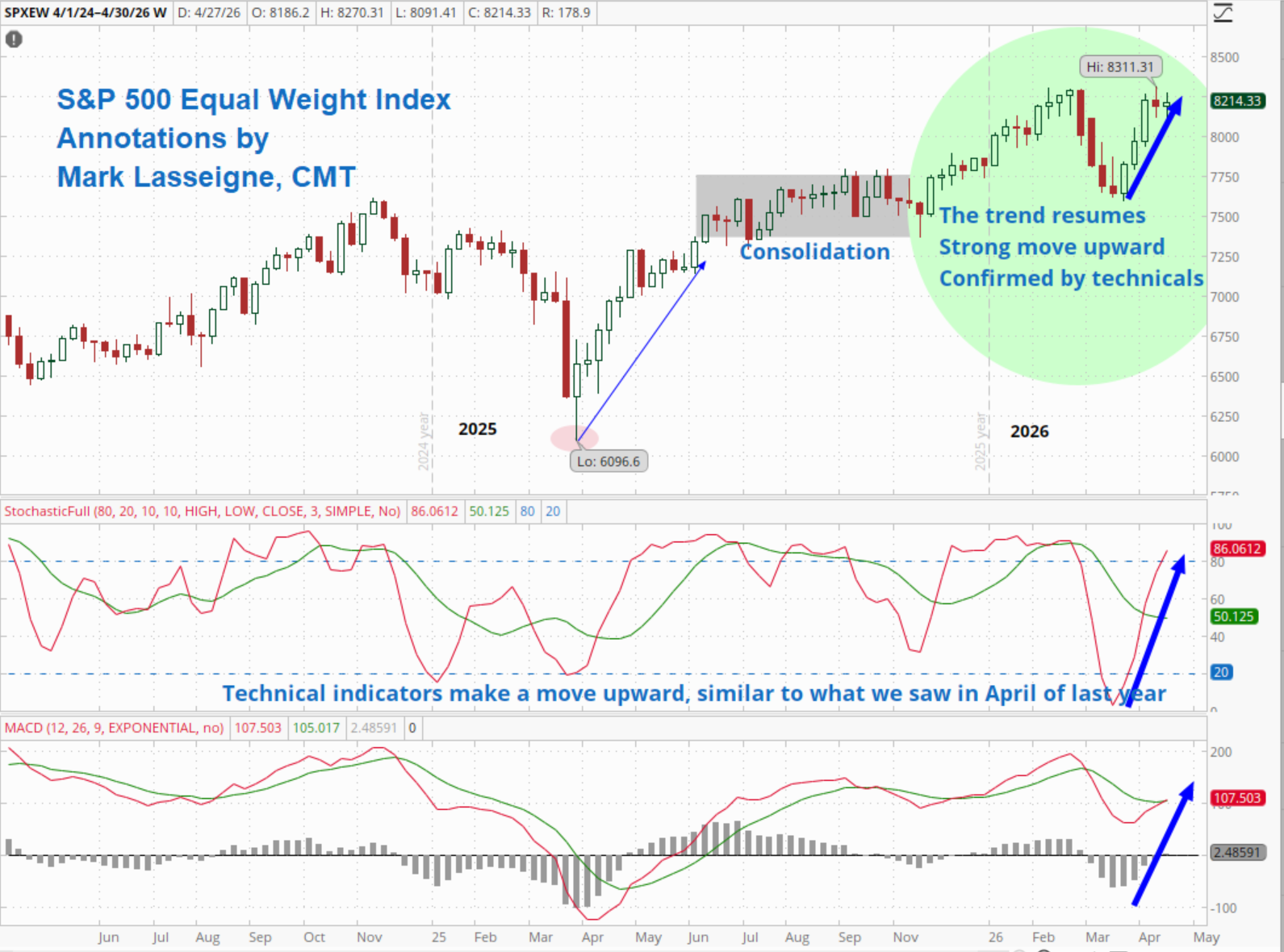
From a technical standpoint, April delivered a decisive resumption of the uptrend on the S&P 500 Equal Weight Index. After a period of consolidation through the winter and early spring, the index broke out of its recent trading range and posted a strong upward move, setting multiple new highs for the year. This advance was accompanied by clear confirmation from the technical indicators. Both momentum oscillators and trend-following tools have turned higher in a manner very similar to the powerful April rally we saw last year. The prior zone of resistance has now been left behind, and price action appears to be building fresh momentum as the market transitions into the second quarter.
While geopolitical tensions and elevated energy prices remain in the background, the Equal Weight Index’s performance underscores broad participation and underlying technical strength. As long as this breakout holds and the indicators continue to support the move, the path of least resistance remains higher. I will continue to monitor for any signs of exhaustion or failure at these elevated levels. I view this current technical setup as constructive and consistent with the fundamentally resilient environment described in our market commentary.
Timely Tax Tidbits
Retirement as a formal idea and lifestyle is a relatively modern concept. For most of human history, people worked until they were physically unable and then relied on family or community support.
It wasn’t until the industrial age that the concept of retirement was born.

In 1875, the American Express Company established the first private pension plan in the United States.
About 15 years later, Germany introduced the first national pension system, allowing older workers to exit the workforce and receive financial support.
By 1899, there were 13 private pension plans in the U.S.
In 1935, Social Security was established, and the first payment was made to Ida May Fuller in 1940 for $22.54.
While relatively new, retirement today is firmly established, making it essential to begin planning for life after work decades in advance.
Last month, we discussed Social Security.
Social Security will help supplement retirement income, but additional resources are required to support your needs and lifestyle after work ceases.
This month, we will provide a brief overview of the various vehicles that are now offered via legislation that can help fund your retirement.
Creating Our List
Retirement accounts are simple in concept—tax-deferred savings that are available to you in retirement. But the details can be confusing. So, we’ll keep the discussion high-level, focusing on retirement options available outside employer-sponsored plans like 401(k)s and 403(b)s.
Which option may be most beneficial for your situation? Let’s explore various account choices. If you have questions, we’re happy to help you find the right approach. As with any tax-related issues, feel free to check in with your tax advisor.
1. Individual Retirement Account, or IRA.
As the name indicates, the account is opened by an individual, and it’s independent of an employer. Anyone who has earned income may contribute to an IRA account. If eligible, contributions are tax deductible. Earnings and capital gains in the IRA are tax deferred. Taxes are paid only when funds are withdrawn.
In 2026, the maximum IRA contribution across all IRA accounts is $7,500 if less than 50 years old. If you are 50 or older, you may contribute up to $8,600.
Advantages:
- Tax-deductible contributions if eligible
- Tax-deferred growth
- Ability to name beneficiaries (avoids probate)
- Flexibility of investment options
- Simple to open
- Record-keeping by brokerage or bank
Disadvantages:
- Taxes paid at withdrawal
- Early withdrawal penalties
- Complexities regarding deductibility issues that arise from one’s own company retirement plan or a spouse covered at work
- Required minimum distributions (RMDs)
2. Roth IRA
If you are eligible to open and contribute to one, contributions are made with after-tax dollars, and qualified withdrawals are not subject to federal income taxes.
A Roth has similar advantages and disadvantages to a traditional IRA. Though there are some differences. A Roth enables you to make tax-free withdrawals in retirement, and RMDs are not required. But contributions are made with after-tax dollars.
3. SEP IRA
Business owners have the option of setting up a Simplified Employee Pension Individual Retirement Account, or what is commonly called a SEP IRA.
A SEP IRA is an employer-funded retirement plan that allows a business owner to make contributions to IRAs set up for themselves and their employees.
Self-employed individuals, independent contractors, and small and large businesses can take advantage of SEP IRAs.
Unlike an IRA, the business owner makes the tax-deductible contribution into his or her own account as well as employees’ accounts. Employees receive the same percentage of their pay as the owner. In other words, if the owner contributes 15% of compensation, employees receive 15% in their respective plans.
In some respects, the SEP IRA is like a pension for the employees, as employees don’t contribute to the account. However, unlike a pension, it is a defined contribution plan, as it has a specific account balance, similar to a 401(k). Additionally, it can operate like a profit-sharing plan, giving the employer flexibility to boost contribution rates (reward employees) during more profitable years.
For 2026, the maximum amount of compensation considered when calculating contributions is $360,000. For self-employed owners, net earnings must be reduced by both the retirement contribution itself and the self-employment tax, resulting in an effective contribution rate of about 20% of net earnings.
The SEP IRA contribution limit for 2026 is 25% of an employee’s total compensation, up to $72,000.
Advantages:
- Potentially high contribution limits vs. an IRA
- Tax-deductible contributions
- Wide investment options
- Easy setup
- Easy to administer
- Flexible contribution amounts year-to-year
- Employee retention and recruitment benefit tool
- Immediate vesting
- Beneficiary option
Disadvantages:
- Withdrawals taxed
- Added employer expense
- No Roth option
- No employee contribution option
- RMDs required
4. Solo (individual) 401(k)
For business owners, the Solo 401(k) is a powerful tool that can be used to defer taxes and save for retirement as long as you are a small business owner with no employees (except your spouse).
In 2026, the maximum you can contribute is $24,500 as the employee plus an additional 25% of compensation as the employer, with additional catch-up contributions if you are 50 or older.
The $24,500 ceiling is a flat dollar limit. This feature is what makes the solo 401(k) such a powerful savings vehicle. For example, someone with $40,000 in earned income could contribute up to $24,500 to the plan under the employee contribution limit without tapping the employer contribution.
In 2026, aggregate contributions are $72,000 if you’re under 50, with an additional $8,000 in catch-up contributions if you’re between 50 and 59 or 64 or older.
If you are between 60 and 63, you may contribute an additional $11,250 in catch-up contributions.
Advantages:
- High limits for lower and moderate incomes
- Roth option
- Availability of employee and employer contribution options
- Year-to-year flexibility on contributions
- Option to add beneficiaries
- Loan features
- No income caps on high wage earners
Disadvantages:
- Greater paperwork, recordkeeping, compliance, contribution tracking, and potential need to engage a third-party administrator
- RMD requirement for non-Roth. (Secure 2.0 Act exempts RMDs in Roths)
- Restrictive loan rules
- Generally not allowed for the owner if the business has employees
At lower income levels, contributions can be substantially higher versus a SEP IRA due to the employee deferral option, but be aware that a solo 401(k) doesn’t share the paperwork simplicity of the SEP IRA. At a much higher income, the SEP IRA may be the easiest option.
5. Finally, let’s review the Health Savings Account, or HSA.
If you have a high-deductible healthcare plan and your plan has an HSA option, you may contribute up to $4,400 as an individual or $8,750 for family coverage. If over 55 or older, you may make an additional $1,000 “catch-up” contribution.
Advantages:
- Tax-deductible contributions
- Tax-deferred growth
- Tax-free withdrawals if used for qualified medical expenses
- A wide array of investment options
- No use-it-or-lose-it that occurs with FSAs.
- Penalty-free withdrawals at age 65 for non-medical expenses—just pay the taxes as with an IRA
- Option to pay Medicare premiums (excluding Medigap) from your HAS
Disadvantages:
- Requires high-deductible healthcare plan
- Record-keeping of expenses
- Withdrawals outside qualified medical expenses may include taxes and a 20% penalty.
If you are healthy and comfortable with a higher deductible, premium savings can be plowed back into an HSA, lowering taxes and providing you with a savings account that can be used for medical expenses.
Moreover, it effectively doubles as a retirement account at 65 years old, as nonqualified withdrawals at 65 are taxed as regular income.
In Conclusion
As demonstrated, there isn’t a shortage of options available. Choosing the right approach, however, depends on your goals, employment status, income, and tax considerations.
If you’ve taken the time to read through this, and are a business owner and self-employed, or the only employees are you and your spouse, you’ve probably noticed how powerful the Solo 401(k). The ability to stash away funds for retirement is. Of all the accounts listed above, this, in my opinion, is the least known, and, for the right situation, can be a life changing tool to use. For solo entrepreneurs and couples who own their business, the Solo 401(k) offers an extraordinary level of control, tax efficiency, and the ability to accelerate retirement wealth accumulation like no other plan. If you’re self-employed, we’d be happy to show you how this powerful strategy can be tailored to your specific situation.
So, if you have questions about any of these other accounts, we’re here to walk through your options and help find the best fit for you. As your goals or personal circumstances evolve, we can help guide any necessary mid-course adjustments.

Through faith-based guidance, we help you review and refine your financial strategies so that your plans for your children’s education and your long-term financial goals can build lasting legacies, honor God, and provide financial peace for generations to come.
We are committed to helping you pursue financial contentment and peace through a plan designed specifically for you—one that aligns your investments with your Christian values. It begins with understanding how you want to live and what matters most to you. Whether your goal is to spend more time with family, serve your community, or use your gifts to make the world a better place, we help you prepare to steward your time, talents, and financial resources in ways that reflect your priorities and your faith.
Implementing Biblically Responsible Investing begins much like any other investment management process—we are still searching for excellent investments. The difference is that we seek opportunities to deliver strong, long-term results while also aligning with the values and principles that are important to you.
“He who supplies seed to the sower and bread for food will supply and multiply your resources and increase the harvest of your righteousness.” — 2 Cor 9:10
Contact Us for a Free Consultation
