

Mark on the Markets
March 2026
Stormy Headlines, Steady Strategy: Staying Focused During Geopolitical Market Volatility
In the early hours of February 28, global markets were shaken by significant geopolitical developments as the U.S. and Israel carried out coordinated strikes on Iran that resulted in the death of Iran’s Supreme Leader. Iran responded with missile strikes, escalating tensions and raising uncertainty across global markets.
It’s not surprising to see heightened volatility in the early stages of a conflict, especially one without a clear endgame or diplomatic resolution in sight.

A short-term “risk-off” response, with pressure on equities and upward movement in oil prices due to potential supply disruptions, is a typical market reaction in this environment. The U.S. dollar has also strengthened, benefiting from global inflows as it resumes its traditional role as a safe-haven currency during times of uncertainty.
In moments like these, it’s natural to feel uneasy. Headlines are dramatic, markets react quickly, and the pace of events can make even seasoned investors uncomfortable.
But here are a few important things we want to emphasize:
1. Market volatility is normal during a geopolitical crisis
Market behavior in response to geopolitical events often follows a familiar pattern: an initial reaction (which can sometimes be sharp), a rise in volatility, and then a gradual reset as investors attempt to price in the economic implications.
History shows that in the immediate aftermath of major geopolitical events, markets often stabilize more quickly than many expect. While uncertainty may linger, markets tend to shift their focus back to economic fundamentals.
How these hostilities may ultimately affect the broader U.S. economy is still unknown, but we believe that economic conditions at home will play a larger role for investors over the medium and long term.
2. Your financial plan and volatility
We construct portfolios with the understanding that unforeseen events will occur—whether geopolitical tensions, economic shifts, policy changes, or unexpected global shocks.
Your financial plan incorporates diversification, risk management, and a disciplined long-term strategy designed to help weather periods of turbulence. While volatility can feel uncomfortable in the moment, it is an expected part of long-term investing.
3. Staying invested remains the most reliable long-term approach
Periods like these can tempt investors to make quick, emotion-driven decisions. However, history repeatedly shows that reacting to headlines often leads to worse outcomes than staying disciplined and committed to a long-term strategy.
Markets have endured wars, recessions, pandemics, political crises, and unexpected global shocks. Through it all, patient investors who maintained a long-term perspective have historically been rewarded.
4. We are monitoring developments closely
While we do not recommend making investment decisions based on short-term news or emotions, we are actively monitoring the situation, the market’s response, and any potential implications for portfolios.
If market conditions warrant adjustments, we will communicate proactively and thoughtfully.
Final Thoughts
The events unfolding in the Middle East are serious, and markets may remain volatile in the coming days and weeks. But volatility alone is not a reason to abandon a well-constructed financial plan.
We navigate moments like these by staying disciplined, thoughtful, and focused on what we can control.
As always, we encourage you to reach out if you have questions, concerns, or simply want to talk through what this may mean for your personal financial plan. We are here to provide clarity, perspective, and guidance—especially when the news cycle feels overwhelming.
February “Cha-Cha”
Continuing the upbeat start to the year, the market appeared to be shifting gears in February and began moving more like a familiar dance—the Cha-Cha. Stocks glided steadily higher, sometimes stepping forward, and then taking a few steps back, and shuffling sideways as investors worked through a new wave of uncertainty.
Markets rarely move in straight lines for long, and February offered a reminder of that reality. Following January’s advance, stocks spent the month bouncing up and down while investors reassessed expectations for several key sectors, most notably technology.

One of the main drivers behind the market’s shuffle has been artificial intelligence. AI has been a powerful force behind market leadership over the past couple of years, but recent developments have caused some investors to reconsider positions that have been big winners.
Concerns have surfaced that AI could disrupt certain profitable business models, particularly among software companies that rely on subscription-based services. According to Yahoo Finance, the S&P index of software companies has fallen roughly 20%, making it one of the sharpest pullbacks within technology.
Still, the market’s reaction may simply reflect profit-taking after an exceptional run-up in technology stocks over the past year. The speed of the decline in some software names suggests a “shoot first, ask questions later” mentality among investors.
After all, AI models are not on the verge of replacing well-established companies overnight. Many of these firms recently reported solid quarterly earnings, and their products remain deeply embedded in corporate operations.
Some analysts even argue the concerns may be overstated. Rather than cannibalizing software companies, AI could enhance productivity and accelerate innovation as firms develop entirely new software products and services.
While technology stocks were busy doing their “Cha-Cha” in February, other areas of the market noisily stepped forward. According to StockCharts, energy, industrials, materials, and consumer staples have all posted double-digit returns since the beginning of the year.
Energy has been one of the clearest examples of the market stepping forward—particularly relevant for many of our clients in Texas and Louisiana. Strength in the sector has been supported by rising crude prices, as investors factor in tighter supply conditions, legitimate concerns about potential supply disruptions in the Strait of Hormuz, and broader regional instability. While energy stocks can benefit from these dynamics in the near term, their recent leadership also reinforces a broader message for investors: diversification matters. Different sectors tend to lead at different points in the market’s dance, and energy’s momentum is helping balance the market as other areas, particularly technology, take a breather.
This shift highlights an encouraging trend: market leadership is broadening. For much of last year, returns were dominated by a small group of mega-cap technology companies. A healthier market environment typically involves a wider mix of sectors participating in the advance.
A broader mix of leadership can help support overall market stability. If volatility persists in technology shares, strength in other sectors, like the rise we are seeing in the energy sector, may help cushion the broader indexes.
For long-term investors, that rhythm is nothing new. Markets move in cycles of advance, pause, and renewal. And if February taught us anything, it’s that even when the market appears to be dancing around, it may simply be gathering energy for its next move.
So, while February may not have delivered dramatic gains, it certainly kept investors on their toes. The market spent the month doing its own version of the Cha Cha—a step forward, a step back, and a shuffle sideways, and a step forward again.
Tariffs Overturned
Well, not all tariffs—but the tariffs the president has predominantly used since taking office last year, including the so-called Liberation Day tariffs imposed last April.
In a landmark ruling, the Supreme Court struck down tariffs enacted under the International Emergency Economic Powers Act (IEEPA), finding that the law did not grant such broad authority for long-term trade measures. The decision could reshape how future administrations use emergency economic powers.
Nonetheless, the president remains undeterred in his desire to use tariffs to shape U.S. trade policy.
He still has other options available. With the exception of one untested Depression-era law, other avenues are not as sweeping as those used under IEEPA.
Some require formal investigations and consultations with federal agencies. Others limit the size, scope, and duration of tariffs, making them more targeted—but also slower to implement.
Private Credit
Lending provided by non-bank institutions has also drawn our attention. Private credit has grown rapidly in recent years as banks pulled back from certain types of lending, allowing private funds to fill the gap.
These loans are often extended to middle-market companies and structured with floating interest rates, which can benefit lenders but increase pressure on borrowers when rates rise.
Transparency remains limited since many loans are illiquid, privately negotiated, and lightly regulated compared with traditional bank lending. Because pricing and credit quality are not always visible in real time, risks may take longer to surface.
As economic growth moderates, some analysts worry that stress in private credit could emerge unevenly if weaker borrowers struggle to refinance or service higher borrowing costs.
It’s not a major problem today, but it remains an area worth watching.
Private credit markets have expanded quickly, and periods of slower economic growth can sometimes reveal weaknesses that were less visible during stronger conditions. For now, it simply deserves careful monitoring rather than immediate concern.
| Key Index Returns |
|
|
|---|---|---|
|
|
MTD % |
YTD % |
|
Dow Jones Industrial Average |
0.2 |
1.9 |
|
NASDAQ Composite |
-3.5 |
-2.5 |
|
S&P 500 Index |
-0.9 |
0.5 |
|
Russell 2000 Index |
0.7 |
6.1 |
|
MSCI World ex-USA** |
2.9 |
9.6 |
|
MSCI Emerging Markets** |
2.7 |
14.7 |
|
Bloomberg U.S. Agg Total Return |
1.6 |
1.7 |
Source: Wall Street Journal, MSCI.com, Bloomberg, MarketWatch
MTD returns: January 30, 2026—February 27, 2026
YTD returns: December 31, 2025–February 27, 2026
**in U.S. dollars
Mark on the Charts
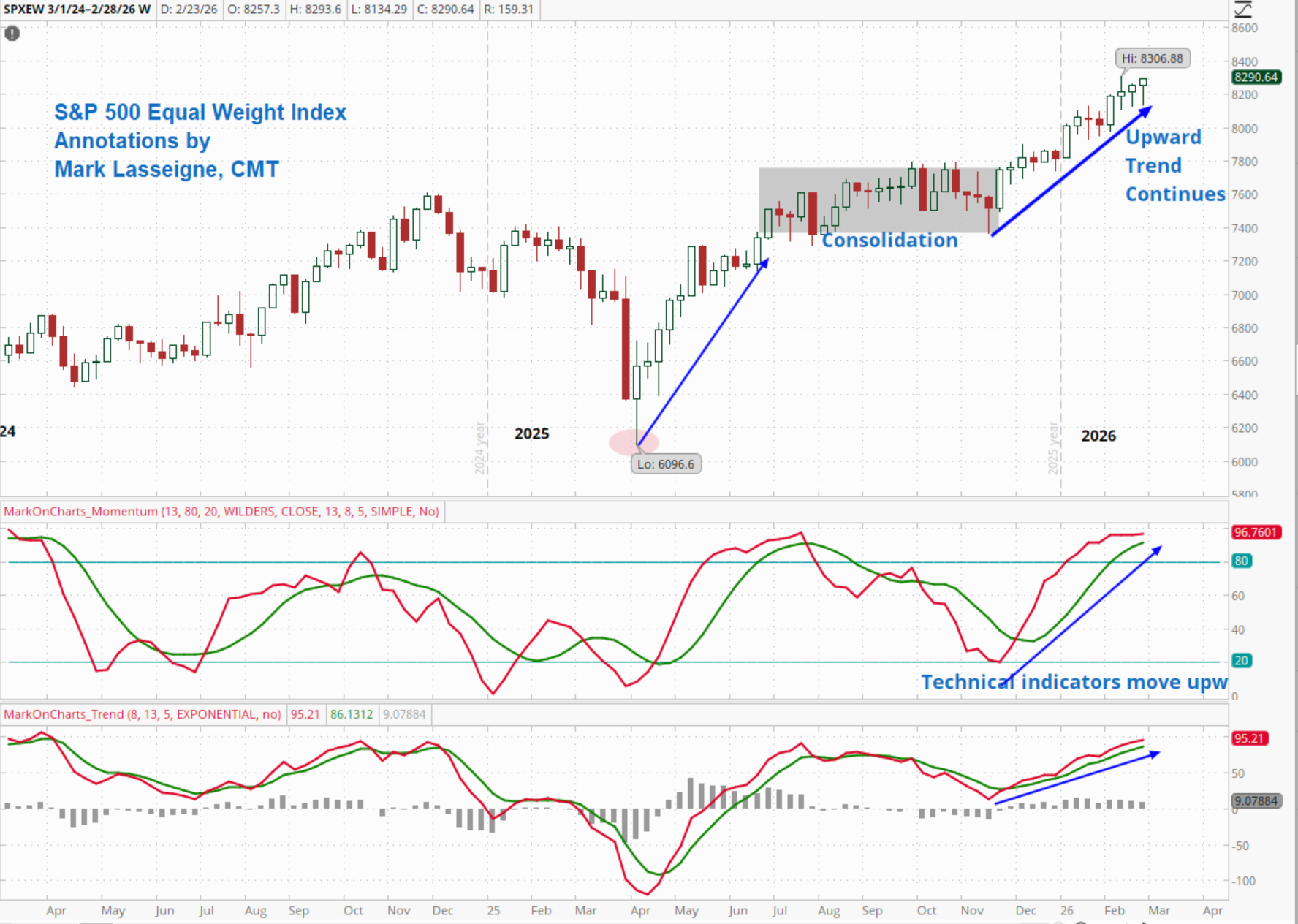
From a technical perspective, February’s movements resemble the kind of action that often occurs after periods of consolidation. Looking at the weekly chart of the S&P 500 equally weighted index, the market’s behavior reflects a steady rhythm of alternating weekly gains and declines—much like the steps of the “Cha-Cha” itself. And the steps are continuing to move higher.
While market volatility frustrates investors, it serves an important purpose. By allowing sentiment to cool and valuations to stabilize, these periods can help build a stronger foundation for future advances.
Timely Tax Tidbits
Smart Tax Moves That Saves You Money
Whether you put an “exclamation point” on the 2025 tax year over the coming weeks or file an extension, this is an opportune time to offer up smart tax moves that can save you money when you file and put you on the path to saving money in tax year 2025 and 2026.

Insurance through the Affordable Care Act (also known as Obamacare)?
If you are receiving a subsidy for your monthly premium, you want to be very careful that your income does not exceed the eligibility limit, which is 400% of the poverty line. Please note that enhanced subsidies expired in 2025, and the so-called “benefits cliff” returns in 2026.
Also, please note that some state calculators might not have the latest 2026 income guidelines. Income limits are based on modified adjusted gross income (MAGI). For most, your AGI (adjusted gross income) is identical to your MAGI.
What is MAGI?
It’s not a line on your tax return. MAGI equals AGI + certain adjustments added back in. The adjustments can vary by situation and may include non-taxable Social Security payments and foreign-earned income exclusions.
Reviewing the guidelines for the 48 contiguous states plus D.C., the poverty line in 2026 is $15,960 for a household of one.
If that individual earns just $1 more than 400% of the poverty line, approximately $63,840, they will be required to repay the entire premium, which could mean a tax bill approaching $10,000. It depends on the person’s age. The older the individual and the lower the initial income estimate, the greater the subsidy.
Younger folks will receive a much lower premium. Still, you’ll be forced to return it if your income exceeds the threshold.
For a family of two, the threshold is approximately $86,560. If you receive that monthly subsidy, you could be liable for up to $20,000 if the limit is exceeded.
That is a painful awakening, and one must be careful with wages, dividends, interest, capital gains, and retirement withdrawals, which risk pushing a recipient of the subsidy over the limit.
MAGI also affects Medicare Premiums
For those with higher AGIs, you can expect to pay more for insurance.
For example, individuals with a MAGI between $109,000 and $137,000 and married couples with a MAGI between $218,000 and $274,000 will pay an additional $81.20 per month for Part B and an additional $14.50 per month for prescription drug coverage, according to Social Security.
This rises to an additional $487 and $91 per month for individuals with a MAGI of $500,000 or more and married couples with a MAGI of $750,000 or more.
With this in mind, let’s review various ways you may lower your MAGI for tax years 2025 and 2026.
- Are you eligible to contribute to a traditional IRA?
For 2025, the total contributions you make for all of your traditional and Roth IRAs must not exceed $7,000 ($8,000 if you’re age 50 or older). The last day to make a contribution for tax year 2025 is April 15, 2026.
For tax year 2026, the total contributions you make each year to all of your traditional IRAs and Roth IRAs may not exceed $7,500 ($8,600 if you’re age 50 or older), or if less, your taxable compensation for the year.
For example, if your taxable compensation is low—let’s say $3,000—your contribution cannot exceed $3,000 for that year.
Consider a spousal IRA—an IRA owned by a nonworking person with a working spouse.
While Roth IRAs can be quite advantageous, as withdrawals are designed to be tax-free if certain rules are met, your contribution is not tax-deductible and won’t lower your MAGI.
You can contribute to a traditional or Roth IRA even if you participate in another retirement plan through your employer or business. However, you may not be able to deduct all your traditional IRA contributions if you or your spouse participates in another retirement plan at work. Roth IRA contributions are limited if your income exceeds a certain level.
If you are self-employed, you may consider a SEP-IRA, which has much higher contribution limits—for 2025, the limit is 25% of an employee’s total compensation, up to $70,000. The SEP IRA contribution limit for 2026 is 25% of an employee’s total compensation, up to $72,000.
You can set up a SEP plan for a year that is as late as the tax due date (including extensions) of your business’s income tax return for that year. In other words, if you haven’t filed your 2025 business return, you may consider a SEP-IRA for 2025.
- Is your health insurance plan HSA- (health savings account) eligible?
If so, you may contribute up to $4,300, or $5,300 if you are 55 or older.
In tax year 2026, that rises to $4,400, or $5,400 if you are 55 or older. You have until the tax deadline to make the contribution—April 15 for tax year 2025.
Withdrawals used for eligible healthcare expenses are tax-free.
If you are 65 or older, you may withdraw from your HSA to pay for Medicare premiums. Additionally, you may also withdraw from an HSA without penalty for non-qualified expenses if you are over 65, but you will pay taxes on the withdrawal. There are no required minimum distributions (RMDs).
- RMDs will increase your AGI and MAGI.
Deadlines for RMDs—You generally must start taking withdrawals from your traditional IRA, SEP IRA, SIMPLE IRA, and retirement plan accounts when you reach age 73.
You have until April 1st of the year after you turn 73 to take your first RMD.
If you turned 73 in 2025, your first RMD is due by April 1, 2026, and your second RMD is due by December 31, 2026.
If you turn 73 this year, you may wait until April 1, 2027, to take your first RMD, but if you place two RMDs into tax year 2027, you run the risk of landing in a higher tax bracket in 2027.
The One Big Beautiful Bill Act (OBBBA) creates several new tax benefits, including…
- Beginning in the 2026 tax year, non-itemizers may deduct cash donations to an eligible charity—up to $1,000 for single filers or $2,000 for married couples filing jointly. Please note that only CASH donations are eligible for a deduction. Noncash items, such as clothing or household goods, donated to a charity do not qualify.
For those in the 37% bracket, only 35% of the donation is tax-deductible.
Itemizers that make charitable contributions may claim a tax deduction to the extent that qualified contributions exceed 0.5% of their AGI. For example, a couple with an AGI of $300,000 could only deduct charitable donations exceeding $1,500.
- Starting in 2027, the OBBBA introduces a new tax credit that allows you to claim up to $1,700 per person when you donate to organizations that provide scholarships for private or religious K–12 schools.
You can take this credit even if you don’t itemize your deductions.
- Additionally, as we’ve discussed before, there are new benefits that apply to overtime, tips, and Social Security.
Because tax rules are complicated, we’re here to help where we can. For advice specific to your circumstances, your tax advisor can provide personalized guidance.
File Smartly
Preparing now, gathering documents, understanding changes from recent laws, and choosing the right filing method make compiling and filing your 2025 taxes smoother, reduce errors, and maximize refunds or minimize what you owe. These steps are straightforward ways to improve your family's finances. No one really knows every detail of your specific situation, so use IRS.gov tools, tax software previews, or consult a professional for personalized guidance. Getting ahead in March sets you up for a stress-free filing season.
Our Key Financial Data Card
Once again, we published our Key Financial Data Card for this year. This is a custom resource that provides the most up-to-date tax brackets, thresholds, limitations, exemptions, and more!

Through faith-based guidance, we help you review and refine your financial strategies so that your plans for your children’s education and your long-term financial goals can build lasting legacies, honor God, and provide financial peace for generations to come.
We are committed to helping you pursue financial contentment and peace through a plan designed specifically for you—one that aligns your investments with your Christian values. It begins with understanding how you want to live and what matters most to you. Whether your goal is to spend more time with family, serve your community, or use your gifts to make the world a better place, we help you prepare to steward your time, talents, and financial resources in ways that reflect your priorities and your faith.
Implementing Biblically Responsible Investing begins much like any other investment management process—we are still searching for excellent investments. The difference is that we seek opportunities to deliver strong, long-term results while also aligning with the values and principles that are important to you.
"But those who wait on the Lord shall renew their strength; they shall mount up with wings like eagles; they shall run and not be weary; they shall walk and not faint." Isaiah 40:31
Contact Us for a Free Consultation
