

Mark on the Markets
June 2026

Bull Didn’t Get the Memo
Tariffs. Rising yields. A war in the Middle East. And yet the market just posted one of its strongest months in years. Here’s the full story and why what happened in small-cap America may be the most telling signal of all.
At the heart of our investment philosophy is a simple conviction: that stewarding wealth well means staying grounded. Not panicking when headlines darken and not abandoning discipline when optimism runs hot. The month of May gave us plenty of reasons to do both, and the market rewarded those who stayed the course with a quiet but powerful reminder that principled investing finds its footing even in uncertain terrain.
With that as our backdrop, let’s walk through exactly what happened last month, why it matters, and what it could mean for the months ahead.
A Market That Shrugged at the Storm
Wall Street entered May carrying a fair amount of baggage. The conflict involving Iran had pushed gasoline prices higher and rattled commodity markets. Tariff questions, still unresolved on the legal front, were nudging businesses to pass some costs along to consumers. Treasury yields were creeping upward, an unwelcome development for anyone hoping for relief on borrowing costs or equity valuations.
And then there was the Federal Reserve. Earlier this year, the conversation on Wall Street centered on when the Fed might cut interest rates with at least one reduction widely expected in 2026. That script quietly flipped in May. With inflation pressures lingering and the labor market showing renewed firmness, the tone shifted: instead of cuts, some analysts began penciling in the possibility of a rate hike later in the year. That’s a meaningful pivot in market psychology.
And yet the major stock indexes kept climbing. Strong momentum that began in April carried right through May, with new highs notched across the board. The question worth asking is: what exactly overcame all of that noise? The answer, in a word, profits.
Companies Are Making More Money Than Anyone Expected
The first quarter of 2026 turned out to be one of the strongest earnings seasons in recent memory. Across the S&P 500, the 500 largest U.S. companies, profits grew at the fastest rate since late 2021. More importantly, the vast majority of companies did better than Wall Street analysts had predicted, and by a wide margin.
What made this season especially notable wasn’t just the big names at the top. Companies across the board, mid-sized, smaller, and across many industries, all reported strong results. That breadth of participation is usually a healthy sign.
“When the whole economy — not just the giants — is profitable, that’s the market telling us something real about underlying strength.”
Why Small Companies Matter More Than You’d Think
Most market coverage focuses on household names, the biggest companies you’ve heard of. But there’s another index worth watching: the Russell 2000, which tracks 2,000 smaller American companies. Think regional manufacturers, community banks, local healthcare providers, and growing technology firms.
These smaller companies are important because they do almost all of their business right here in the U.S. Unlike giant multinationals that can offset a weak American economy with overseas sales, small caps rise and fall with Main Street. When they’re doing well, it’s a genuine vote of confidence in the American economy, not just Wall Street.
Heading into this earnings season, small-cap companies were expected to post their strongest profit growth in over a year, and analysts believe that recovery is real and durable.
One Risk Worth Watching: Interest Rates
There’s a wrinkle in this otherwise positive story. Rising interest rates hit smaller companies harder than large ones. Big corporations often lock in long-term, fixed-rate loans, so when rates go up, their costs don’t immediately change. Smaller companies tend to carry loans that adjust with rates, meaning higher rates translate more directly into higher expenses.
If the Federal Reserve does raise rates later this year, it will be worth watching how small-cap companies hold up. But for now, their earnings momentum is encouraging.
What This Means for You
May is a reminder that markets often tune out short-term noise when the fundamentals are solid. Investors who stepped back, spooked by tariff headlines, rising rates, or overseas conflict, likely missed a meaningful stretch of gains.
The core takeaway is straightforward: American companies are profitable, broadly and deeply. That’s the engine underneath the market’s strength, and it’s exactly why staying the course, even when the headlines are noisy, tends to be the right call.
| Key Index Returns |
|
|
|---|---|---|
|
|
MTD % |
YTD % |
|
Dow Jones Industrial Average |
2.8 |
6.2 |
|
NASDAQ Composite |
8.4 |
16.1 |
|
S&P 500 Index |
5.1 |
10.7 |
|
Russell 2000 Index (Smaoo-Cap) Index ★ |
4.3 |
17.6 |
|
MSCI World ex-USA** |
2.4 |
7.9 |
|
MSCI Emerging Markets** |
9.5 |
25.8 |
|
Bloomberg U.S. Agg Total Return |
0.3 |
0.4 |
★ Russell 2000DSmall-Cap Index highlighted as the focus index for this month’s commentary.
MTD returns: April 30, 2026 – May 29, 2026 | YTD returns: December 31, 2025 – May 29, 2026
** In U.S. dollars | Returns shown are price returns unless otherwise noted.
Sources: Wall Street Journal, MSCI.com, Bloomberg, MarketWatch. Dow, S&P 500, and Nasdaq May MTD returns independently confirmed via Advisor Perspectives / ETF Trends (June 2026).
Mark on the Charts
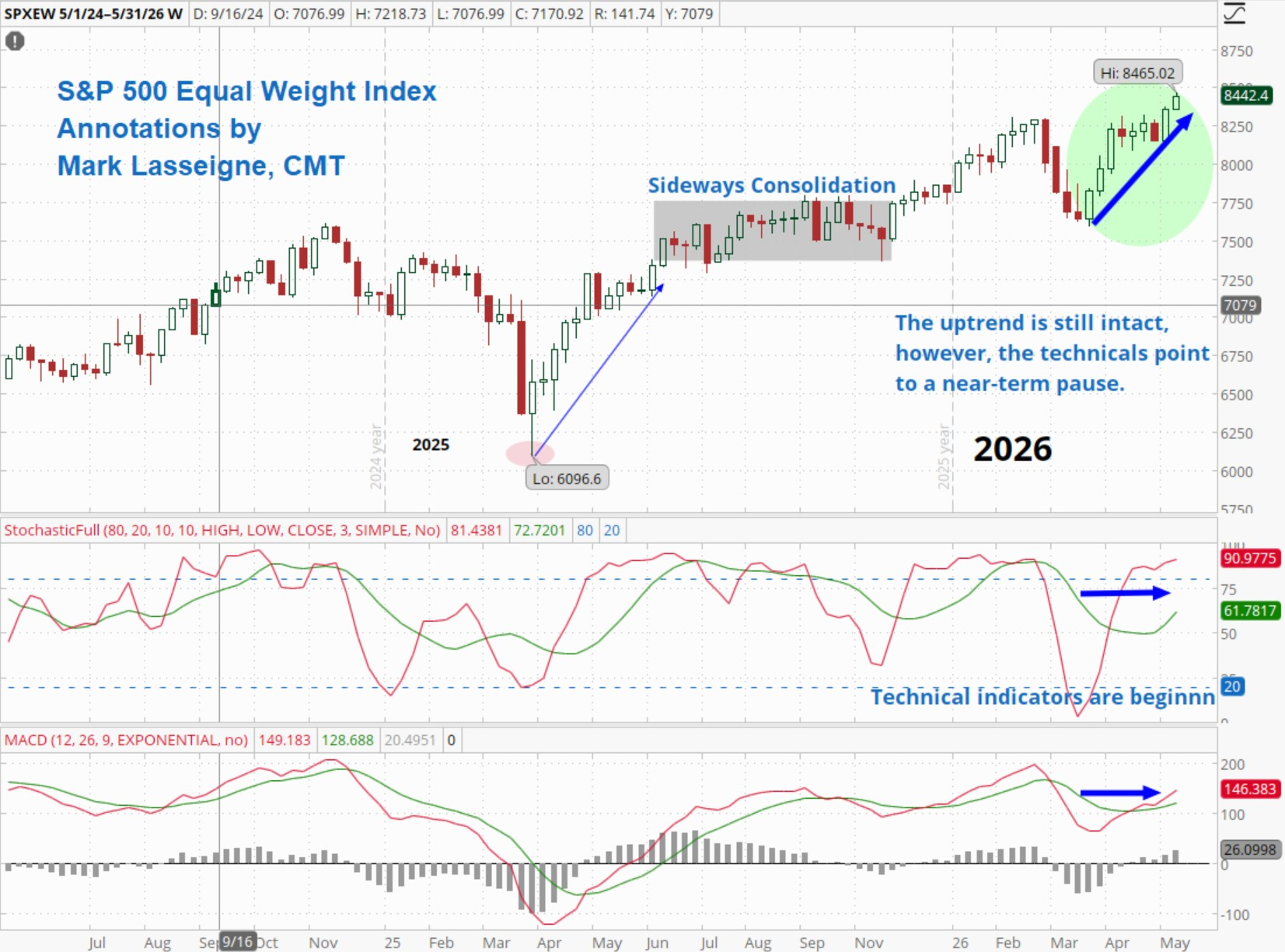
May delivered a strong continuation of the uptrend on the S&P 500 Equal Weight Index, and arguably the most important confirmation of the year so far. After holding its footing during the winter correction, the Equal Weight Index accelerated sharply through April and May as broad market participation returned in force.
The full-year chart tells a constructive story. The February and March pullback was orderly, with no technical breakdown or violation of key support, and the subsequent recovery extended forcefully into May, with the index setting fresh highs. Momentum indicators have confirmed the move, and sector participation remains wide. I will continue to monitor for any signs of exhaustion or a rotation back toward narrow mega-cap leadership, but as of the close of May, the technical setup is as constructive as it has been all year.
Timely Tax Tidbits
If the first half of 2026 has felt unsettled, that's because it has been. Markets have lurched on tariff headlines, reversed on earnings beats, stumbled on Fed commentary, and rallied again on signals that the economy remains resilient.
That pattern is unlikely to resolve itself neatly in the second half of the year. In fact, I expect volatility to remain an active feature of this market for the foreseeable future.
I want to be direct about that. Not to alarm you, but because I think you deserve honesty over reassurance.
The Headlines Are Not Your Friend
Turn on financial television or scroll through market news on any given morning, and you will encounter two competing emotions: fear and urgency. The financial media is not in the business of calm. It is in the business of attention, and nothing captures attention faster than a market in motion, either plunging or soaring. The result is a steady drumbeat of narratives designed to make you feel that something must be done. Sell before it gets worse. Buy before you miss it. Act now.
That noise is not analysis. It’s theater. And for undisciplined investors, it is one of the most expensive forms of entertainment available.
The research on this is consistent and unambiguous: investors who trade in and out of markets in response to short-term volatility almost invariably underperform those who stay the course. The damage is not just from selling at the wrong time. It is from missing the recovery. Some of the best single days in market history have occurred in the middle of the worst stretches. Miss those days, and the long-term math changes dramatically.
We Have Been Here Before
It is worth remembering what volatility actually looks like in context. Since 1980, the S&P 500 has experienced an average intra-year decline of approximately 14%, yet the index has finished positive in roughly three out of every four calendar years. Corrections are not anomalies. They are the price of admission for the long-term returns that markets have historically delivered.
We have navigated the financial crisis of 2008, a global pandemic, the fastest rate-hiking cycle in four decades, and a geopolitical landscape that has rarely felt more unsettled. Each of those periods, in the moment, felt like it might be different. Many thought the damage might be permanent. It never was. The investors who stayed disciplined, who resisted the urge to act on fear, who kept their eyes on the horizon rather than the daily noise, those investors were rewarded.
That history does not guarantee any particular outcome from here. But it does provide a useful frame for what we are navigating today.
What I Am Focused On
My approach has not changed, and it will not change because of a volatile headline cycle. What I am focused on, as I always am, is the long-term picture.
That means looking for well-run companies with durable competitive advantages, strong balance sheets, and earnings trajectories that hold up across market cycles. Companies that are not merely riding a trend, but building something real: real products, real cash flows, real staying power. When markets sell off indiscriminately, as they sometimes do, those companies often become more attractive, not less.
For clients whose profiles call for income and stability, I am also focused on companies with strong dividend histories. Businesses that have demonstrated the financial discipline to return cash to shareholders consistently, even through difficult environments. A well-chosen dividend-paying stock does something a volatile market cannot take away: it pays you while you wait. That income stream, reinvested or distributed depending on your needs, is a powerful component of long-term wealth building.
The right mix of growth-oriented and income-oriented holdings is not the same for every client. It depends on your timeline, your goals, your risk tolerance, and what you are ultimately trying to accomplish. That is a conversation we have together, and one I take seriously.
The Bottom Line
Volatility is uncomfortable. That discomfort is real, and I do not dismiss it. But discomfort is not the same as danger, and motion is not the same as progress. The investors who build lasting wealth are rarely the ones who move fastest. They are the ones who stayed the course when moving felt most tempting.
That is the philosophy this practice is built on. It is not exciting. It does not make for dramatic television. But it works for patient investors who understand that the long game is the only game worth playing.
If the market noise is weighing on you, please reach out. That conversation is always worth having.

Through faith-based guidance, we help you review and refine your financial strategies so that your plans for your children’s education and your long-term financial goals can build lasting legacies, honor God, and provide financial peace for generations to come.
We are committed to helping you pursue financial contentment and peace through a plan designed specifically for you—one that aligns your investments with your Christian values. It begins with understanding how you want to live and what matters most to you. Whether your goal is to spend more time with family, serve your community, or use your gifts to make the world a better place, we help you prepare to steward your time, talents, and financial resources in ways that reflect your priorities and your faith.
Implementing Biblically Responsible Investing begins much like any other investment management process—we are still searching for excellent investments. The difference is that we seek opportunities to deliver strong, long-term results while also aligning with the values and principles that are important to you.
“Therefore we will not fear, though the earth should change, though the mountains shake in the heart of the sea, though its waters roar and foam, though the mountains tremble with its tumult.” — Ps 46:2-3
Contact Us for a Free Consultation
