

Mark on the Markets
February 2026
January Barometer
Global markets continue to deliver strong performance, but there's been a clear shift in leadership among U.S. stocks.
Notably, the tech-heavy Nasdaq Composite lagged with only modest gains, while smaller company stocks, as measured by the more speculative Russell 2000 Index, sprinted out in front with impressive returns. The equal-weighted S&P 500 also outperformed its cap-weighted cousin (with the equal-weight version up around 3.4% for the month versus the standard S&P 500's roughly 1.4% gain), pointing to broader participation across sectors and styles.

Though we're only through the first inning, we're seeing the rally broaden out, which is encouraging. Optimism that the U.S. economy will keep accelerating has fueled this market rotation, encouraging investors to seek out companies whose fortunes are more closely tied to the business cycle. Fed rate cuts from late 2025 have also given smaller companies and cyclicals a nice tailwind.
| Key Index Returns |
|
|---|---|
|
|
January 2026% |
|
Dow Jones Industrial Average |
1.7 |
|
NASDAQ Composite |
0.9 |
|
S&P 500 Index |
1.4 |
|
Russell 2000 Index |
5.3 |
|
MSCI World ex-USA** |
4.7 |
|
MSCI Emerging Markets** |
8.8 |
|
Bloomberg U.S. Agg Total Return |
0.1 |
Source: Wall Street Journal, MSCI.com, Bloomberg, MarketWatch
January 2026 returns: December 31, 2025–January 30, 2026
**in U.S. dollars
A slow start for the Nasdaq doesn't necessarily mean the AI boom is over. Profit-taking, greater selectivity among investors, and some concerns about market concentration may just be at play, along with divergence in big tech earnings, where names like Meta rallied sharply while others like Microsoft faced pressure from spending guidance.
Geopolitical headlines added some chop early in the month, including U.S. military action in Venezuela (which temporarily boosted energy stocks and oil prices), threats of potential strikes on Iran, friction with NATO allies over Greenland, and renewed tariff talk toward Europe, Canada, and South Korea. These created uncertainty and currency whipsaws (with a weaker dollar at times), but markets proved resilient as some tensions eased or were dialed back (like a framework deal with NATO). Late in the month, President Trump's nomination of Kevin Warsh as Fed Chair. Warsh is viewed as more hawkish on inflation and less dovish on aggressive rate cuts, and this sparked the dollar's strongest rally in months, some pressure on precious metals, and repositioning away from ultra-rate-sensitive assets. Still, the overall close was positive, with the S&P 500 finishing up about 1.4% and broader indices showing even stronger gains.
January Barometer
The so-called January Barometer holds that the market’s performance in January, as measured by the S&P 500 Index, often foreshadows how stocks will perform during the year.
Since 1970, January finished higher 33 times and fell 23 times (excluding 2026’s advance; St. Louis Federal Reserve data; excludes reinvested dividends).
How accurate is the barometer? As illustrated in Table 2, a positive January coupled with a positive year occurred 29 times since 1970. Simply put, when January finished higher, the S&P 500 gained ground 29 times. The average increase: around 19%.
There were only four years in which January was positive, but the year finished lower. The average loss was about 5.2%. If January posts a decline, all is not lost, but an up year is less likely.
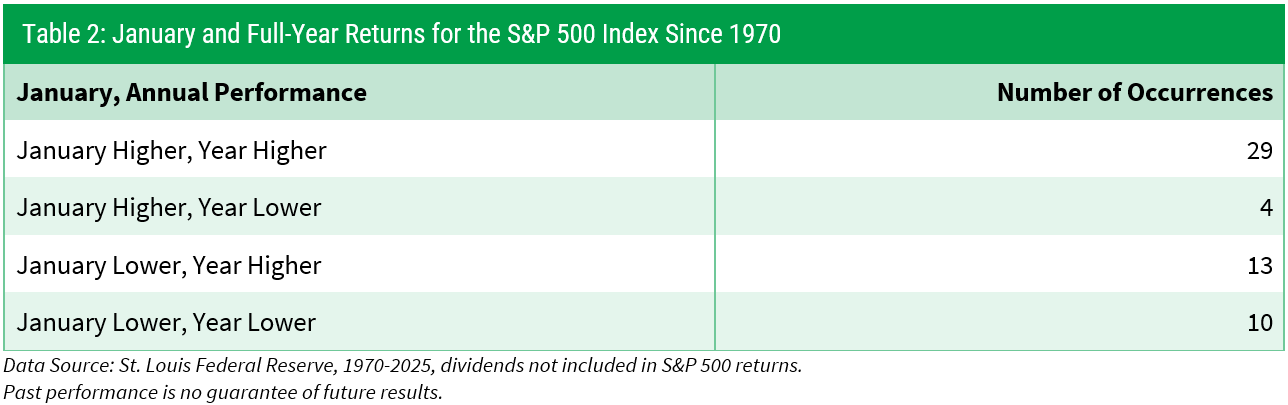
When January finishes higher, the January Barometer has been a ringing endorsement for the full year, though let’s not discount the possibility of market pullbacks, as we saw last year.
Why does a positive start typically result in a favorable year? If the year begins on a favorable note AND indexes tend to move higher, bullish sentiment has the upper hand. Put another way, the bears are starting out at a disadvantage AND must overcome the market’s tendency to move higher.
However, a strong start to a year can be derailed by policy missteps, recessions, rising interest rates, or other unexpected economic headwinds.
Still, tools like the January Barometer provide interesting signals, not guarantees. Market performance is still driven by economic fundamentals, as history has consistently demonstrated.
Looking ahead to February and the rest of 2026, a few things could sway the path: Lingering catch-up on delayed economic data from any prior government shutdown effects (retail sales, industrial production, housing, etc.) might create some volatility as numbers roll in. Upcoming jobs reports, inflation prints, and the ongoing Senate confirmation process for Warsh will be closely watched for Fed policy clues—potentially heating up debates on central bank independence. Earnings season continues with more big tech and broader reports, where guidance surprises could either reinforce the rotation or spark selectivity.
For the full year, the outlook stays cautiously optimistic, with many strategists eyeing mid-teens S&P 500 earnings growth (around 13-15%) from broadening AI capex, resilient consumer spending, and fiscal support like tax cuts. Broader leadership in small caps, value, internationals, and cyclicals could stick if acceleration holds, but risks remain from sticky inflation, trade frictions, geopolitical flashpoints, or higher rates. No one really knows exactly how it plays out, but January's positive close, the historical Barometer strength, and supportive fundamentals keep the bias tilted toward gains—though expect more selectivity and potential pullbacks than the narrow rallies of recent years.
Bottom Line
January 2026 showed a market that was resilient amid some choppy headlines, geopolitical noise, and policy shifts, yet it managed to close higher with broadening participation, a positive continuation from late last year. The key remains staying grounded: focus on your long-term objectives, maintain a diversified approach that aligns with your risk tolerance, and avoid knee-jerk reactions to the inevitable ups and downs. This evidence-based mindset has served patient investors well through many cycles, and we believe it will continue to help navigate whatever 2026 brings, whether more rotation, selectivity in AI themes, or the occasional pullback. No one really knows the exact path ahead, but with fundamentals supportive and history favoring positive starts like this one, the bias stays constructive for those who stay the course.

Energy Sector:
A Strong Start to 2026 Driven by Rising Power Demand
The energy sector got off to a solid start in 2026. While the overall stock market only rose modestly in January, energy stocks performed much better. The S&P 500 Energy Index climbed about 14% for the month. Several factors helped: cold winter weather increased heating demand, geopolitical tensions created some uncertainty, and most importantly, the massive electricity needs of AI data centers continued to grow. In key production areas like Texas and Louisiana, companies are benefiting from this trend, especially those focused on natural gas, which is in steady demand for power generation, while oil faces more challenges from global oversupply.
Crude oil prices stayed under pressure early in the year. West Texas Intermediate (WTI), the main U.S. oil benchmark, traded in the low to mid $60s per barrel by late January -slightly higher than the end of 2025, but still reflecting concerns about too much oil being produced worldwide. U.S. shale producers and other non-OPEC countries are pumping out more oil than current demand requires, which keeps prices from rising sharply. Geopolitical events, such as U.S. military actions in Venezuela, threats involving Iran, and tensions in the Middle East, caused short-lived price spikes that lifted energy stocks temporarily. However, the basic supply-and-demand picture soon took over again. Oil companies are staying disciplined: they’re limiting new drilling spending, protecting their cash flow, hedging against price drops, and focusing on efficiency instead of rapid growth.
Natural gas told a stronger story. Prices at Henry Hub (the key U.S. natural gas pricing point) saw big swings, spiking above $12 per million BTU during mid-January winter storms before pulling back, but overall remained supported by tight supply and growing demand. AI data centers are consuming far more electricity than in the past, and natural gas power plants are the most reliable and flexible way to meet that constant, high-volume need. Exports of liquefied natural gas (LNG) to Europe and Asia also stayed strong, pulling more gas out of the system. Companies in the midstream sector that transport and store gas under long-term contracts delivered steady, predictable returns. This split between weaker oil and stronger natural gas echoes what happened in 2025, but the AI-driven power demand is accelerating fast. It’s leading to more pipeline construction, grid upgrades, and job opportunities in energy-producing regions.
Our Take
We believe the growing demand from AI data centers—combined with broader commodity needs for power and industry, is setting the stage for higher natural gas and energy prices later in 2026. No one can predict the exact timing or path - geopolitical risks could escalate, oversupply pressures might linger, or AI growth could exceed even the boldest forecasts -but the structural increase in reliable energy demand keeps the outlook positive for companies well-positioned in natural gas, pipelines, and efficient operations.
Mark on the Charts
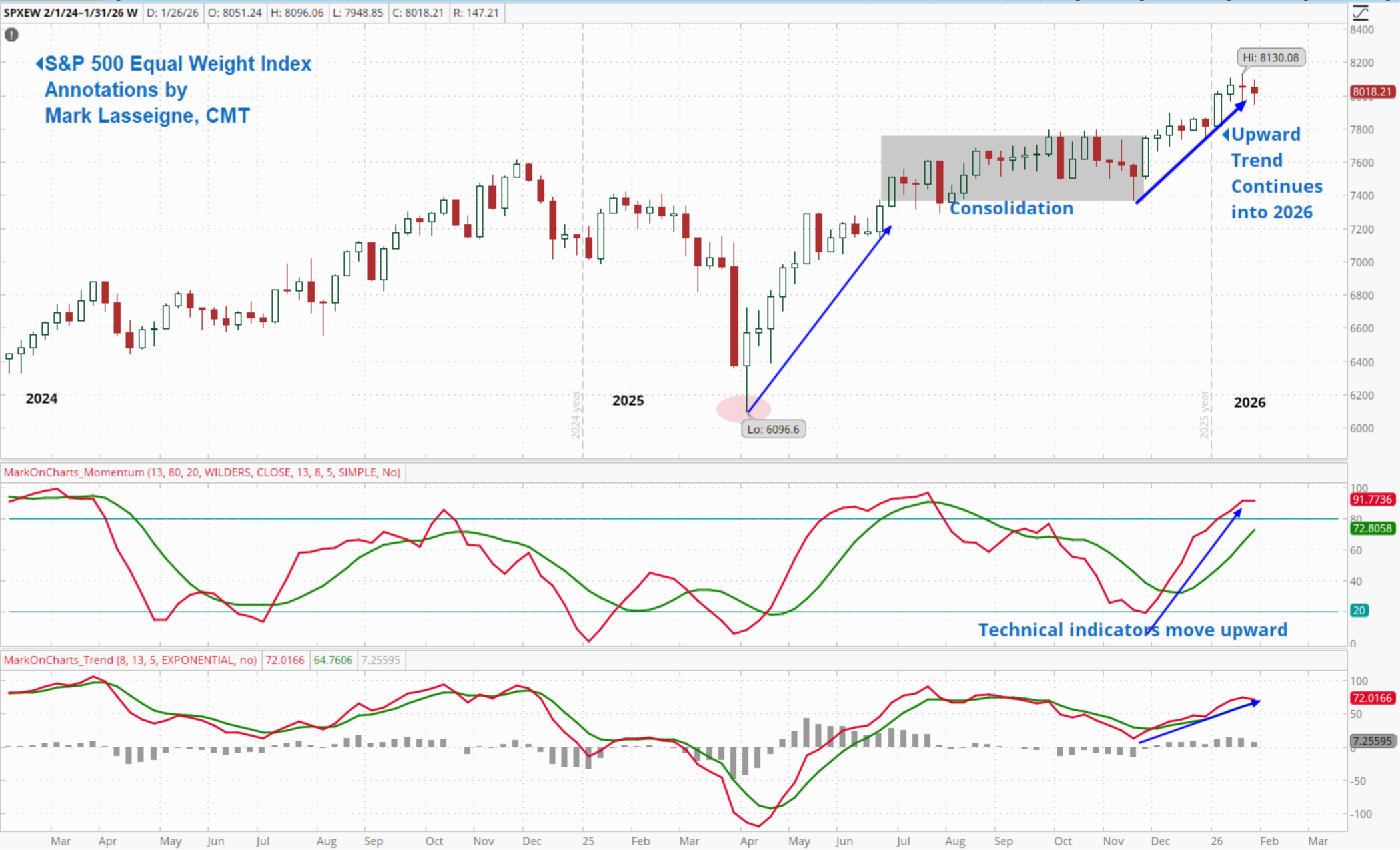
After building on the positive momentum from late 2025, the market kicked off the new year with a steady advance in January. Market consolidations are not a bad thing; they often recharge the engines before the next leg up. Think of it like a brief winter nap after the holiday feast, where the body rests and then wakes up ready for more action. This weekly chart of the S&P 500 equally weighted index paints a clear picture. We saw the upward trend from December continue into January, with broader participation helping the equal-weighted version outperform the cap-weighted benchmark. The white and red bars on the chart below show the weekly ups (white bars) and downs (red bars), highlighting a solid month of gains without major pullbacks. The consolidation phase from mid-2025 has given way to renewed strength, and technical indicators remain supportive. No one really knows what the rest of 2026 holds, but January's positive close, coupled with historical patterns like the January barometer, is an encouraging sign.
Timely Tax Tidbits
How to Best Prepare for Compiling and Filing Your 2025 Taxes
With tax filing season underway since late January 2026, now is the ideal time to get organized for your 2025 federal income tax return (the one you'll file this year). The deadline is April 15, 2026 - a Wednesday this year - for most people to file and pay any taxes owed.

Thanks to the One Big Beautiful Bill Act signed last summer, many provisions from the 2017 Tax Cuts and Jobs Act are now permanent, including the larger standard deduction, seven tax brackets (10% to 37%), and family credits like the Child Tax Credit. These changes generally mean more money stays in family pockets. Here's a practical guide to prepare efficiently and avoid common pitfalls.
Step 1: Gather All Your Essential Documents Early
Start by collecting everything you'll need to report income, deductions, and credits accurately. Key items include:
- W-2 forms from employers (due to you by January 31, 2026) showing wages and withheld taxes.
- 1099 forms for freelance work (1099-NEC or 1099-MISC), interest/dividends (1099-INT/DIV), retirement distributions (1099-R), or other income like gig economy payments (possibly 1099-K if you had high-volume transactions).
- Records for deductions or credits: mortgage interest statements (1098), property tax bills, charitable donation receipts, medical expenses, student loan interest, childcare receipts (for the Child and Dependent Care Credit), and tuition payments (1098-T).
- Last year's return for reference, plus any estimated tax payments made in 2025. Organize them in folders (digital or physical) by category—wages, investments, deductions—to make inputting data easier. If something's missing, contact the issuer right away to avoid delays.
Step 2: Review Your Situation and Plan for Key Changes
Take a quick look at how 2025 might affect your return.
- The standard deduction is higher (around $15,750 for singles, $31,500 for married filing jointly, with extra for those 65+), so most families won't itemize unless they have big mortgage interest, high state/local taxes (SALT cap temporarily raised in some cases), or other large deductions.
- The Child Tax Credit is up to $2,200 per qualifying child under 17 (with part refundable), and the Earned Income Tax Credit offers solid support for working families.
Newer perks like potential deductions for tips, overtime pay, or auto loan interest (with limits) could apply if relevant to your household. Check your withholding on recent paystubs If you owed a lot last year or got a big refund, adjust Form W-4 now to avoid surprises. Use the IRS Interactive Tax Assistant or withholding estimator on IRS.gov for quick checks.
Step 3: Choose Your Filing Method and File Smartly
Decide how to file:
- Free options include IRS Free File (for lower/moderate incomes, starting early in the season) or Free File Fillable Forms.
- Many use tax software (like TurboTax or H&R Block) for guided preparation and error checks—great for spotting overlooked credits. Or hire a reputable preparer if your situation is complex (e.g., self-employment, investments).
- File electronically: it's faster, more accurate, and gets refunds quicker (often within 21 days via direct deposit). Set up direct deposit if you haven't already, as the IRS is phasing out paper checks.
- If you need more time, file Form 4868 for an automatic extension to October 15, 2026, but pay any estimated taxes owed by April 15 to avoid penalties.
Bottom Line
Preparing now, gathering documents, understanding changes from recent laws, and choosing the right filing method makes compiling and filing your 2025 taxes smoother, reduces errors, and maximizes refunds or minimizes what you owe. These steps are straightforward ways to benefit your family financially. No one really knows every detail of your specific situation, so use IRS.gov tools, tax software previews, or consult a professional for personalized guidance. Getting ahead in February sets you up for a stress-free filing season. Here's to a smooth process and keeping more in your pocket this year!
Our Key Financial Data Card
Each year, we publish our Key Financial Data Card. This is a custom resource that gives you the most updated tax brackets, thresholds, limitations, exemptions, and more! We should have this ready soon and will mail it out to all clients.

Through faith-based guidance, we help your review and refine your strategies, ensuring preparation for your children’s education will build lasting legacies, honor God, and secure financial peace for future generations.
We’re committed to helping you experience financial contentment and peace through a plan that’s right for you, and by aligning your investment with your Christian values. It’s about understanding how you want to live and what you want to do. Whether you want to spend time with family or volunteer to make the world a better place, we help you prepare to spend your time, talents, and resources on what matters most to you.
Implementing faith-based investing begins just like any other investment
management process – we’re looking for great investments!
Here's to a year of faithful endurance and hopeful gains ahead.
"But they who wait for the Lord shall renew their strength; they shall mount up with wings like eagles; they shall run and not be weary; they shall walk and not faint." Isaiah 40:31
Contact Us for a Free Consultation
