

Mark on the Markets
December 2025
Another year of gratitude!
As the holiday season unfolds and a new year draws near, we pause to cherish the beautiful moments we’ve shared. Christmas is a sacred time of love, generosity, and faith, and we joyfully seize this moment to send our warmest wishes to you and your loved ones.
The heart of Christmas celebrates the birth of Jesus Christ—our enduring symbol of hope, peace, and God’s infinite love. This holy season invites us to live compassion, kindness, and goodwill toward everyone. In that same spirit, we offer heartfelt thanks for the trust and confidence you have so graciously shown us.
May the message of Christmas—peace, joy, and abiding hope—dwell richly in our hearts. We pray the year ahead brings you abundant success, prosperity, and lasting happiness. We feel truly blessed by every opportunity to serve you and eagerly anticipate the ongoing strengthening of our partnership.
Thank you for your trust and confidence, and for allowing us to be an integral part of your life!
“For today in the city of David a savior has been born for you who is Messiah and Lord. And this will be a sign for you: you will find an infant wrapped in swaddling clothes and lying in a manger.” And suddenly there was a multitude of the heavenly host with the angel, praising God and saying: “Glory to God in the highest and on earth peace to those on whom his favor rests." Luke 2:11
Wishing you a Merry Christmas and a blessed New Year!
AI Bubble Pops… Fed Saves It
While the tech-heavy Nasdaq Composite slipped last month, both the Dow Jones Industrial Average and the S&P 500 shook off a modest mid-month decline to notch their seventh consecutive monthly advance, according to MarketWatch.
What happened during that mid-month dip? Over six trading days, the S&P 500 Index declined modestly by 4.6% amid fears that the AI boom could lead to an AI bust.

Let’s start with a big picture view. Driven by surging demand for computing power, McKinsey & Company projects that global investment in data centers could reach $6.7 trillion by 2030. But forecasts are never set in stone, and projections vary widely, according to McKinsey.
Last month, high valuations for AI-focused technology companies came under the microscope, and market volatility, while still subdued, picked up. But let’s be real, too. Forecasts aren’t guarantees, and visibility beyond the short term is limited, as the pace of AI innovation makes future demand hard to pin down. As McKinsey noted, “A lack of clarity about future demand makes precise investment calculations difficult.”
In part, massive capital expenditures are raising red flags. This year alone, major tech firms plan to pour about $400 billion into AI efforts, according to The Wall Street Journal. And they say it isn’t enough amid soaring demand for their products. Given the huge outlays, it’s still unclear when these companies might see meaningful returns. Moreover, many of the most prominent players are now tapping debt markets to fund cloud and AI projects, a notable shift from their general reliance on cash reserves.
And then there’s OpenAI, the privately held powerhouse behind ChatGPT. It’s a central figure in the AI boom, but investors worry it might be over-leveraged, over-committed, and overvalued. Its business model seems to depend on unbridled optimism in capital markets to sustain its cash needs as it ramps up capacity to meet demand. With huge spending plans and mounting losses that may roll into 2029 or 2030, OpenAI seems to be a risky bet, according to some folks, even as it remains one of the most influential players shaping the future of AI.
Yet, others argue that concerns are overblown. Revenues at OpenAI are rising quickly—driven by paid subscriptions to ChatGPT—and enterprise adoption is strong. Moreover, OpenAI has deep ties to the world’s largest technology firms, and it is beginning to diversify beyond ChatGPT.
In Summary…
The Bull Case: OpenAI could become the backbone of global AI, drive massive revenue growth while using strategic partnerships to keep costs under control.
The Bear Case: Spending might spiral out of control, and governance problems could flare up. If competition heats up or valuations drop, OpenAI could face severe financial strain.
And Then, The Fed: Words Move Markets
Yet, as quickly as the modest bout of volatility flared up, stocks rallied into the end of the month after a Fed official hinted that another rate cut was in the pipeline. When we highlight actions by the Federal Reserve, we rarely reach beyond Fed Chief Jay Powell. Anything else is, well, too wonky and too granular in our view. But the president of the influential Federal Reserve Bank of New York hinted that at least one more rate cut is on the way, and that reignited the rally.
What did he say? “I still see room for a further adjustment in the near term to the target range for the federal funds rate…” That’s all it took.
Let’s decipher. “Adjustment” is FedSpeak for a quarter-point rate cut, and “near term” was taken by investors to mean December.
Why did one speech from an influential regional Fed president move markets so dramatically and remove the spotlight from AI? It’s hard to say for sure, and we can only speculate, but odds are he wouldn’t have floated a December rate cut without Powell’s tacit approval.
| Key Index Returns |
|
|
|---|---|---|
|
|
MTD % |
YTD % |
|
Dow Jones Industrial Average |
0.3 |
12.2 |
|
NASDAQ Composite |
-1.5 |
21.0 |
|
S&P 500 Index |
0.1 |
16.5 |
|
Russell 2000 Index |
0.8 |
12.1 |
|
MSCI World ex-USA** |
0.9 |
24.9 |
|
MSCI Emerging Markets** |
-2.5 |
27.1 |
|
Bloomberg U.S. Agg Total Return |
0.6 |
7.5 |
Source: Wall Street Journal, MSCI.com, Bloomberg, MarketWatch
MTD returns: October 31, 2025–November 28, 2025
YTD returns: December 31, 2024–November 28, 2025
**in U.S. dollars

Energy Sector: Natural Gas Keeps Shining While Oil Stays in the Shadows
Last month, we noted the widening divide between a struggling crude oil market and a resilient natural gas segment. November reinforced that divergence, and with 2026 forecasts now taking shape, here is a straightforward assessment of where things stand and what lies ahead.
Crude oil prices remained under pressure throughout November, closing near $59 per barrel for the domestic benchmark most relevant to Texas producers. Record production from the Permian Basin and robust output from other non-OPEC countries have created a persistent global surplus. At the same time, slower economic growth—particularly in China—has tempered demand. When supply significantly exceeds demand, prices fall, compressing profit margins for exploration and production companies. As a result, the drilling and upstream segments of the energy sector posted flat to slightly negative returns for the month.
Natural gas continued to perform strongly. Prices at the primary U.S. pricing hub rose from approximately $3.44 to nearly $3.80 per million Btu, driven by seasonal weather demand and record exports of liquefied natural gas (LNG) from Gulf Coast terminals. Europe and Asia remain eager buyers as they diversify supply sources. Companies involved in natural gas production, pipeline transportation, and LNG export facilities enjoyed gains in November and have significantly outperformed the broader energy sector this year.
Energy Outlook for 2026
Most credible forecasts suggest crude oil will face continued downward pressure, with average prices potentially settling in the mid-to-high $50s, and brief dips below $50 possible in the first quarter. Motorists will benefit from lower gasoline prices, but drilling activity and upstream profitability will remain challenged until the global inventory overhang is reduced.
Natural gas enjoys a more favorable outlook. Analysts project domestic hub prices averaging around $4.00 or higher next year, supported by growing LNG export capacity, rising electricity demand from data centers, manufacturing reshoring, and population growth across Texas.
This environment continues to favor the more defensive segments—midstream pipelines and LNG infrastructure—that earn stable, fee-based revenue largely independent of commodity price swings. At the same time, pure-play oil producers are likely to experience ongoing volatility.
Mark on the Charts
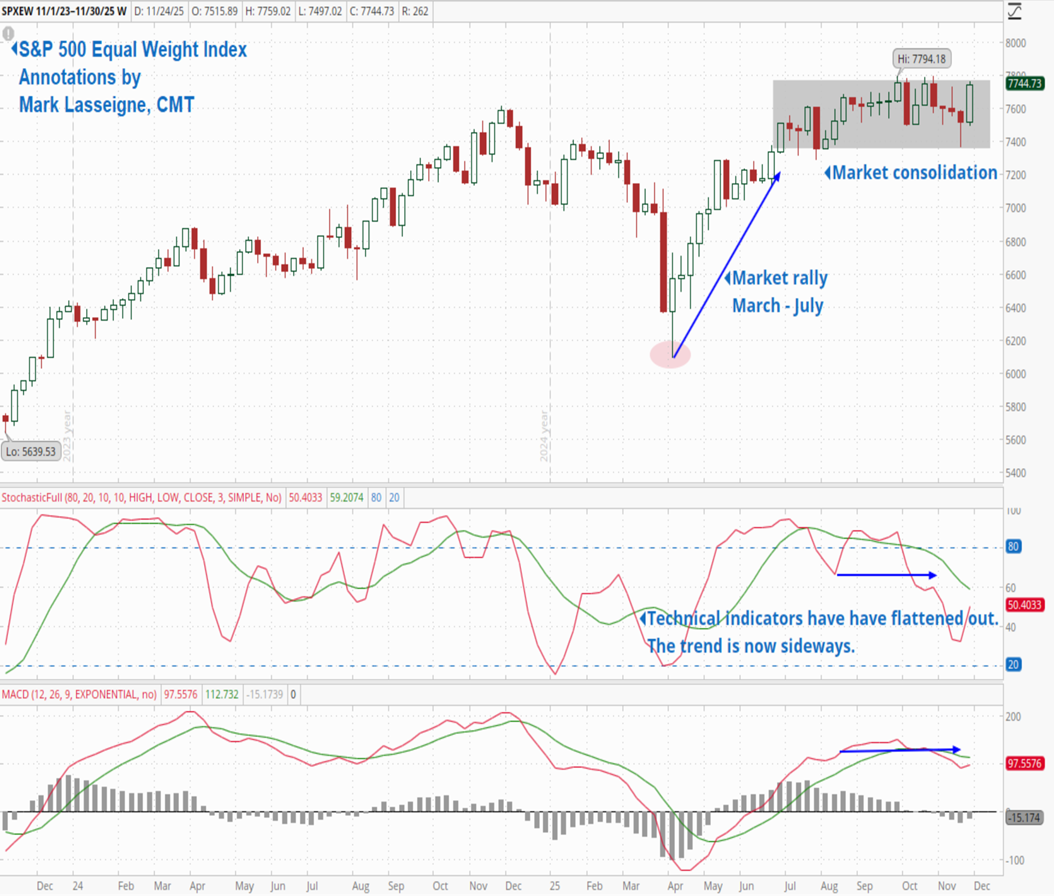
The S&P 500 equally weighted index appears to be in a sideways consolidation. This should not surprise anyone, as markets in November navigated a gauntlet of turbulence that tested the mettle of even the most steadfast bulls. The headwinds were there, as seen in the media, pushing a narrative of overextended valuations in the artificial intelligence arms race that dominated headlines. Along with that, we had whispers of Fed rate cuts in December, fueled by forecasts of softening job prints. This comes at the end of a protracted government shutdown. Finally, news of layoffs is casting a shadow on holiday cheer. All things considered, the market is digesting gains from a positive year. TBD what the next trend direction will be. It’s a reminder that in markets as in life, make hay while the sun shines
Timely Tax Tidbits
5 Genius Year-End Giving Hacks That Slash Your Taxes (Most People Miss #3!)
As 2025 draws to a close, smart donors are turning charity into massive tax savings. Even with fewer people itemizing after tax-law changes, these five proven strategies let you support causes you love while keeping more money in your pocket. Forget boring cash donations—these moves are next-level.

- Ditch Cash – Donate Skyrocketing Stocks Instead
- Avoid capital gains tax completely on appreciated securities held over 1 year
- Get a deduction for the full current market value, not just what you paid
- Super simple—just transfer shares directly to the charity (never sell first)
- IRS rules:
- Deduction limited to 30% of AGI for long-term appreciated securities
- Excess deductions carry forward up to 5 years
- For non-cash gifts over $500, file Form 8283; appraisals required over $5,000
- Slash Taxes with a Qualified Charitable Distribution (Age 70½+)
- Send up to $108,000 ($216,000 for couples) straight from IRA to charity—tax-free
- Counts toward your RMD but never hits your taxable income or AGI
- No double-dipping: Can't claim it as an itemized deduction too
- IRS rules:
- Charity must be a qualified 501(c)(3); no personal benefits allowed, and document in writing
- Applies only to pretax amounts
- Roth Conversion? Use Charity to Cancel the Tax Hit
- Converting a traditional IRA to a Roth triggers ordinary income tax on the amount moved
- A big charitable deduction in the same year can completely offset the conversion tax
- Perfect when you expect higher tax rates later or want tax-free inheritance for heirs
- Turns an expensive move into a near-zero-tax event
- IRS rule:
- Charitable deduction limited to 60% of AGI for cash or 30% for appreciated assetslip>
- Must itemize deductions; excess carries forward 5 years
- Conversion taxed at your marginal rate—time it with high-donation years to minimize bracket creep
- “Bunch” Donations with a Donor-Advised Fund (DAF)
- Contribute a lump sum now → instant tax deduction (even if you grant later)
- Ideal for countering year-end bonuses or surprise high-income years
- Invest the money tax-free inside the fund while you decide where it goes
- Minimums start as low as $5,000 at many sponsors
- IRS rule:
- Cash contributions deductible up to 60% of AGI; appreciated assets up to 30%
- Sponsoring org must be a qualified 501(c)(3) with exclusive legal control; you have advisory rights only
- Excess deductions carry forward up to 5 years; no deduction if it provides donor benefits like fulfilling pledges
- Huge Tax Breaks with a Charitable Remainder Trust
- Transfer appreciated assets → avoid capital gains tax when the trust sells
- Receive steady income for life (or a set term) — fixed or percentage
- Immediate income-tax deduction + removes asset from your taxable estate
- At the end, the remainder goes to your favorite charity
- IRS rule:
- Partial deduction based on present value of charity's remainder interest (after your payments)
- Payments from trust taxed as ordinary income, cap gains, or corpus (tax-free principal last)
- Irrevocable; must be 501(c)(3) remainder beneficiary; file Form 5227 annuallys
The clock is ticking—December 31 is the deadline for 2025 tax benefits. These strategies can save you thousands while doing enormous good. Talk to us or your tax pro today to see which one best fits your situation. Give smarter, not harder!


Why Faith-Based Investing
Seven out of ten Americans say their personal values influence their investment decisions.1 In recent years, values-based investing has grown in popularity as more individuals seek strategies and products that align with their beliefs. As Christians, we are no exception. Our faith shapes every aspect of our lives, including how we manage our finances.
That’s why Financial Cornerstones offers faith-based investing strategies designed to help you align your investments with your Christian values.
What is faith-based investing?
Faith-based investing involves using God-given resources in the capital markets to honor Him and support His Kingdom. For our clients, this means directing investment dollars toward products, services, and industries that uphold biblical principles while aiming for competitive financial returns.
At Financial Cornerstones, we are guided by faith-based values that form the foundation of all our investment strategies.
Our Distinctive Approach to Investing is Built Upon Four Cornerstones:
 Stewardship
Recognizing that all resources belong to God, Christians are called to manage wealth responsibly and in alignment with His purposes. This principle emphasizes intentionality in investments, ensuring they honor God and contribute to societal good.
Ethical Integrity
Investments should align with Christian morals and values. This often means avoiding industries or practices that contradict biblical principles, such as those involving the destruction of life, human trafficking, or immorality (e.g., abortion, pornography, or promotion of anti-family values)
Generosity
A focus on using financial resources to serve others and support Kingdom-focused causes, such as missions, charitable organizations, and community development. This cornerstone emphasizes sharing blessings and fostering economic empowerment.
Long-term Perspective
Viewing investments with eternity in mind, prioritizing sustainability and the broader impact on people and the planet. This perspective encourages patience, the avoidance of greed, and trusting in God's provision over time.
By incorporating these Cornerstones, Christians can invest in ways that reflect their faith and commitment to serving God's purposes.
Go, Make a Difference - With Your Investments!
So, now that we’ve defined faith-based investing, it’s essential for investors to understand how they can participate and align their faith with their finances.
Since our inception, we have offered a suite of portfolios across most major asset classes. Financial Cornerstones helps Christians intentionally connect their faith with their investment decisions to make a lasting impact in the world for the Kingdom of God. We seek to multiply Kingdom impact through Christian investment solutions that enable investors to remain true to their Christian values, leverage investment returns for greater ministry work, and benefit from and support Kingdom impact investments.
Interested in learning more about aligning your faith with your finances through faith-based investing? Explore our advisory services through Financial Cornerstones to see how we can help you steward your resources and make an impact on the Kingdom.
1Charles Schwab & Co., Inc., Modern Wealth Survey conducted by Logica Research, February 2022. Survey consisted of 1,000 Americans, ages 21-75
With faith-based guidance, we help you review and refine your strategies, ensuring that your preparation for your children’s education will build lasting legacies, honor God, and secure financial peace for future generations.
Implementing faith-based investing begins just like any other investment
management process – we’re looking for great investments!
I hope you’ve found this review to be educational and helpful. Our goal is to be a guide to you as you run the race and keep the faith.
"For today in the city of David a savior has been born for you who is Messiah and Lord." Lk 2:11
Contact Us for a Free Consultation
