

Mark on the Markets
August 2026

The Market Found New Leaders in July
For almost two years, a small group of giant technology companies drove nearly all of the market’s gains. In July that changed. The familiar leaders cooled off, and the rest of the market stepped forward to carry the load. On the surface it looked unsettling. Underneath, it was one of the most encouraging developments we have seen in a long while.
At the heart of how we manage money is a simple conviction. Stewarding wealth well means staying grounded, both when the headlines turn dark and when optimism runs hot. July tested that discipline in a particular way. The companies that had led the market for two years finally took a step back, and for anyone watching only the daily headlines, it may have felt like something was breaking. In fact the opposite was true. Below the surface, the market was doing something healthy that it had not done in quite some time. It was spreading out.
A Month That Looked Worse Than It Was
If you followed only the technology headlines, July looked discouraging. The Nasdaq Composite fell 3.2 percent, its second monthly decline in a row, as investors took profits in the large artificial intelligence winners and began asking a reasonable question. Are these companies turning their enormous spending into profits quickly enough to justify their share prices? Because the S&P 500 leans so heavily on those same giants, it finished the month essentially flat.
That tells only part of the story, and the less important part. While the biggest names rested, the typical stock moved higher. The equal-weight version of the S&P 500, which treats every company the same rather than letting a handful of giants dominate, actually reached a record high during the month. The Dow, full of established blue-chip companies, also gained ground. The gap between those results is the real story of July.
A Healthy Rotation
What took place was a rotation, which is simply money moving out of one part of the market and into another. For two years a small group of technology names did nearly all of the work. In July investors put their money to work more broadly, favoring value stocks, banks, and energy producers. Large company value stocks rose close to 4 percent for the month while their growth counterparts fell, a remarkably wide gap to open in just four weeks. Energy led every sector by a comfortable margin, and financials were not far behind. The parts of the market that had been overlooked for a long time finally had their turn.
A market that leans on five or six names is a fragile thing. When those few companies stumble, everything stumbles with them. A market where the gains are shared across many companies and many industries stands on a far wider and sturdier foundation. That breadth is exactly what July delivered, and it is precisely the environment a well-diversified portfolio is built to handle. When leadership shifts, the investor who owns only last year’s winners feels the full force of the pullback, while the investor who holds a broad and balanced mix barely notices, because as one area cools, another begins to warm.
Profits Did the Heavy Lifting
None of this happened by accident. Corporate earnings for the second quarter came in unusually strong. With better than a quarter of the S&P 500 having reported by the end of the month, roughly 86 percent of companies exceeded Wall Street’s profit expectations, and the overall growth rate was tracking near its fastest pace since late 2021. Over time it is profits, and not headlines, that hold a market up, and this season’s profits were both broad and deep.
One Item Worth Watching
The one genuinely cautionary note came from the bond market. Treasury yields climbed sharply, and the closely watched 10-year yield rose to about 4.74 percent by month's end, its highest level of the year. The Federal Reserve held its benchmark rate steady at 3.50 to 3.75 percent at its July meeting, though it is worth noting that three members voted to raise rates. With inflation still running above the Fed’s target, the next move in rates could just as easily be up as down. Rising yields pull bond prices lower, and they tend to press hardest on smaller companies that borrow at floating rates, so this is a development we will keep watching closely.
What This Means for You
July is a good reminder that an alarming headline and an unhealthy market are not the same thing. Anyone who saw “technology falls again” and reached for the sell button missed what was really happening, which was a market growing broader, steadier, and less dependent on a small handful of companies. That is a firmer footing to stand on, not a weaker one. You do not need to guess which corner of the market will lead next. A thoughtfully diversified portfolio participates in the rotation instead of fearing it, and over time that patient, balanced approach is what builds lasting wealth.
“When the market’s gains are shared across many companies instead of a favored few, that is not a sign of weakness. It is the foundation of a durable advance.”
| Key Index Returns |
|
|
|---|---|---|
|
|
July 2026 % |
YTD % |
|
Dow Jones Industrial Average |
+0.3 |
+9.2 |
|
Nasdaq Composite |
–3.2 |
+9.2 |
|
S&P 500 Index |
–0.1 |
+9.4 |
|
Russell 2000 (Small-Cap) Index ★ |
–3.1 |
+18.1 |
|
MSCI World ex-USA** |
+2.1 |
+11.4 |
|
MSCI Emerging Markets** |
–1.9 |
+17.7 |
|
Bloomberg US Agg Total Return |
–1.3 |
–0.5 |
★ The Russell 2000 Small-Cap Index is highlighted this month as the year’s breadth leader. It paused in July but remains the top-performing U.S. index for 2026.
MTD returns: June 30, 2026 to July 31, 2026 | YTD returns: December 31, 2025 to July 31, 2026
** In U.S. dollars, total return. Other returns shown are price returns unless otherwise noted.
Sources: Wall Street Journal Market Data, MSCI.com, Bloomberg, Nasdaq. U.S. equity index July returns independently confirmed via WSJ Market Data Center. International and bond figures confirmed against preferred data feed prior to publication.
Mark on the Charts
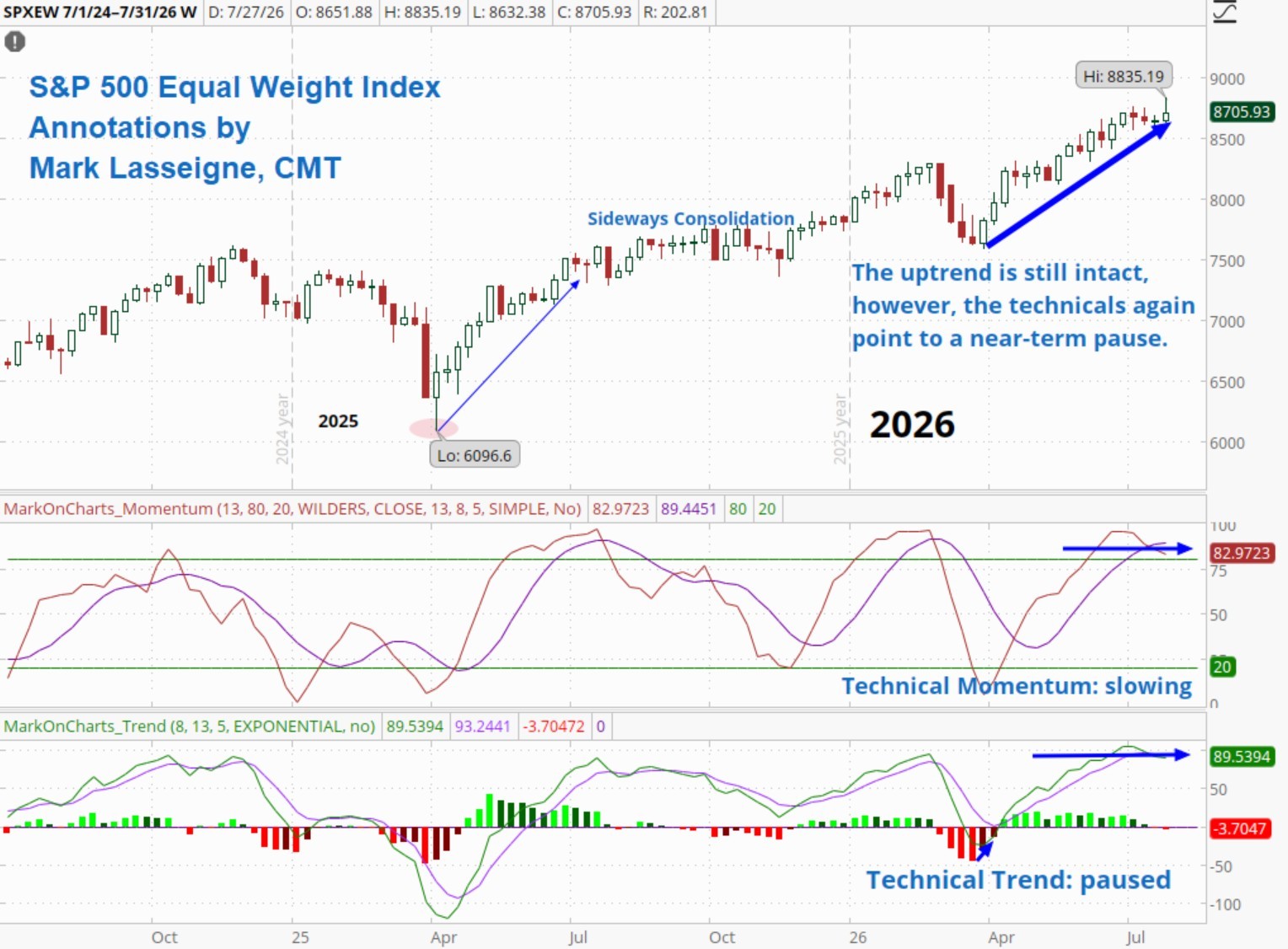
The chart above is the S&P 500 Equal Weight Index, which gives every company in the index the same importance rather than letting the largest few dominate. I follow it closely because it tells me whether an advance is broad and well supported or narrow and fragile. Right now the message is encouraging on the big picture and cautious on the near term.
The primary trend remains firmly higher. From its early 2025 low near 6,097, the index has climbed steadily, worked through a healthy sideways consolidation, and pushed to a fresh high near 8,835 in July. That is a textbook uptrend, and nothing in the longer-term picture suggests it is in jeopardy.
The near term is a different matter. My momentum indicator has begun to slow, and my trend model has paused after leading the advance for months. Neither reading is a signal of a breakdown. Both simply suggest the index may need to rest, consolidate, or pull back modestly before it can extend higher. After a run this strong, a pause would be entirely normal, and even healthy.
So my read is straightforward. The uptrend is intact, and I remain constructive on the broad market, but I would not be surprised by a stretch of consolidation in the weeks ahead.
Timely Tax Tidbits
A Quiet-Season Move Worth Making
Summer is the slow season for tax planning, which is exactly why it is the smart time for it. Two items are worth a look before the year gets away from us.
If you are 70½ or older and you give to your church or a ministry you love, take a close look at the Qualified Charitable Distribution, or QCD. A QCD lets you give directly from your IRA to a qualified charity.

In 2026 you can give as much as $111,000 this way, or $222,000 for a married couple giving from separate IRAs. The gift never counts as taxable income, and if you are taking Required Minimum Distributions, your QCD counts toward satisfying them. For a giving-minded household, it is often the most tax-efficient way to support the work that matters to you.
And a simple calendar note. Third-quarter estimated tax payments are due September 15. If you are self-employed, newly retired, or living partly on investment income, a five-minute check now on your payments and withholding can spare you an underpayment penalty next April.
This is general information, not tax advice, and every situation is different. Please talk it through with your tax professional before acting. I am always glad to be part of that conversation.

Through faith-based guidance, we help your review and refine your strategies, ensuring preparation for your children’s education will build lasting legacies, honor God, and secure financial peace for future generations.
We’re committed to helping you experience financial contentment and peace through a plan that’s right for you, and by aligning your investment with your Christian values. It’s about understanding how you want to live and what you want to do. Whether you want to spend time with family or volunteer to make the world a better place, we help you prepare to spend your time, talents, and resources on what matters most to you.
Implementing faith-based investing begins just like any other investment management process – we’re looking for great investments!
“For I know the plans I have for you, declares the Lord, plans for welfare and not for evil, to give you a future and a hope.” — Jer 29:11
Contact Us for a Free Consultation
