

Mark on the Markets
April 2026

Oil, Conflict, & Corrections
At Financial Cornerstones, we view markets through the lens of stewardship, not speculation. While headlines can stir anxiety, our role is to help you interpret events with clarity, discipline, and a long-term perspective grounded in wise decision-making.
Earlier this year, optimism was high, with some investors even anticipating Dow 50,000. However, February’s enthusiasm gave way to a more sobering March. The Dow Jones Industrial Average entered correction territory, declining by about 10%, while the tech-heavy Nasdaq fell roughly 12% from its peak. The S&P 500 came close to correction levels, down about 9.1%.
Even so, the pullback has been orderly, not panic-driven. In many ways, markets have demonstrated resilience despite meaningful geopolitical tension.
It’s important to understand the real economic forces at work—particularly those tied to the Persian Gulf and the ongoing disruption in the Strait of Hormuz.
1. Energy (Oil)
Energy markets have been in the spotlight. Roughly 15% of the global oil supply flows through the Strait of Hormuz. With that passage constrained, prices have risen accordingly. While the U.S. is less dependent on this region than in decades past, oil is globally priced—meaning higher costs ripple through transportation, manufacturing, and ultimately the prices we all pay.
There are mitigating factors: alternative supply routes, increased non-OPEC production, and strategic reserves. Still, higher energy prices exert economic pressure worldwide.
2. Agriculture (Fertilizer)
Less visible, but equally important, is fertilizer. The Persian Gulf region accounts for a significant share of global urea and ammonia exports, both essential for crop production. While the U.S. is not heavily reliant on direct imports, global pricing affects everyone.
If disruptions persist, reduced agricultural yields could lead to higher food prices—a reminder of how interconnected global systems are, and why prudent planning matters.
3. Technology (Helium & Semiconductors)
About one-third of the world’s helium supply comes from Qatar. Beyond balloons, helium is critical in semiconductor manufacturing. Any prolonged disruption could impact chip production, which underpins everything from smartphones to vehicles.
Even though the U.S. leads in some areas, supply chain constraints would still be felt globally.
Putting It All Together
March reminded us that volatility is part of investing—but it does not necessarily signal instability. Markets experienced increased swings, yet declines remained measured. Investors appear to be balancing concern with confidence.
A resilient U.S. economy, solid corporate earnings expectations, and the belief that central banks will act thoughtfully rather than reactively have helped stabilize sentiment. Additionally, many market participants expect the current conflict to be contained rather than prolonged.
That said, escalation or extended disruption would likely increase volatility.
Our Perspective
Markets will always move through seasons—some calm, others uncertain. Our responsibility is not to predict every outcome, but to remain disciplined, diversified, and aligned with your long-term purpose.
| Key Index Returns | ||
|---|---|---|
|
MTD % |
YTD % |
Dow Jones Industrial Average |
-5.4 |
-3.6 |
NASDAQ Composite |
-4.8 |
-7.1 |
S&P 500 Index |
-5.1 |
-4.6 |
Russell 2000 Index |
-5.2 |
0.6 |
MSCI World ex-USA** |
-10.2 |
-1.5 |
MSCI Emerging Markets** |
-13.6 |
-0.5 |
Bloomberg U.S. Agg Total Return |
-1.8 |
0.0 |
Source: Wall Street Journal, MSCI.com, Bloomberg, MarketWatch
MTD returns: February 27, 2026–March 31, 2026
YTD returns: December 31, 2025–March 31, 2026
**in U.S. dollars
Mark on the Charts
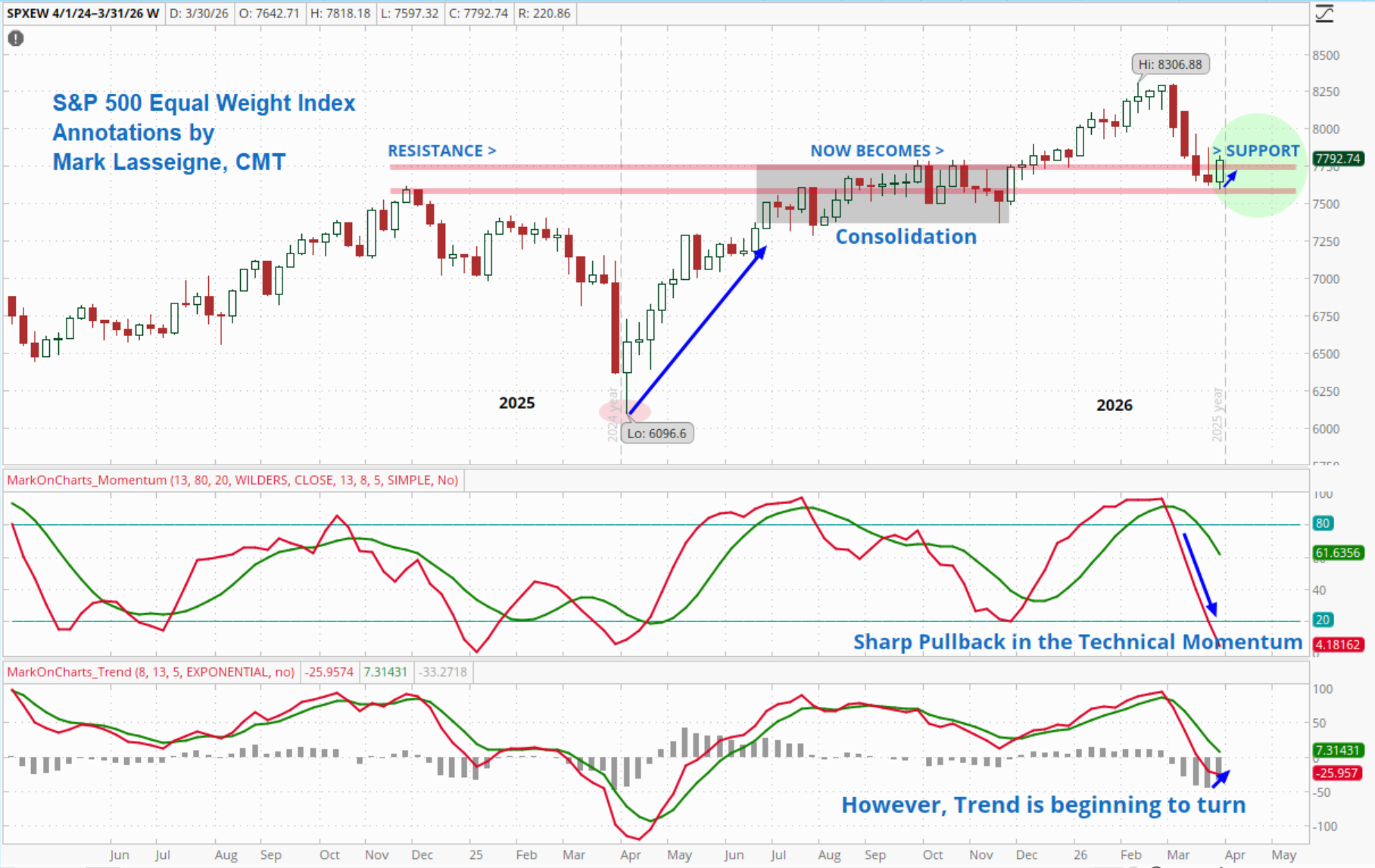
From a technical perspective, March’s price action reflects a healthy, albeit sharp, reset following an extended advance. On the weekly chart of the S&P 500 Equal Weight Index, what was previously a clear zone of resistance has now transitioned into an important area of support, as prices pulled back and tested this level. This type of retest is quite common after breakouts, helping to validate prior gains and establish a more durable foundation. Notably, momentum has pulled back sharply, indicating short-term pressure, while trend indicators are beginning to roll over but have not fully broken down.
In many cases, this combination suggests a market working through near-term excess rather than signaling a complete trend reversal. While volatility has picked up, this process may ultimately reinforce the broader uptrend if support holds in the weeks ahead.
Timely Tax Tidbits
Social Security remains one of the most impactful financial safety nets in the U.S. Today, it helps prevent nearly 29 million Americans from falling into poverty each year. That said, while it provides a foundational level of income, it’s rarely enough on its own to support the kind of retirement most people envision.
That’s why understanding how it works and how to optimize it is so important.

What is Social Security?
At its core, Social Security is a federal program designed to provide income in several situations:
- Retirement
- Disability
- Survivor benefits for families
For our purposes, we’ll focus on retirement benefits, the portion most relevant to your long-term financial plan.
When Should You Start Benefits?
You can begin collecting Social Security as early as age 62, but timing has a meaningful impact on how much you receive.
Key milestones:
- Age 62: Earliest eligibility (reduced benefit)
- Full Retirement Age (FRA): 66–67, depending on birth year (67 for most people today)
- Age 70: Maximum benefit
If you were born in 1960 or later:
- Age 62 → about 70% of your full benefit
- Age 67 → 100%
- Age 70 → about 124%
Each year you delay (up to age 70) increases your monthly income.
A Simple Example
If your full benefit at 67 is $1,000/month:
- At 62 → about $700/month
- At 70 → about $1,240/month
That’s a significant difference over time.
The Break-Even Question
A common question is: Should I take it early or wait?
Generally:
- Claiming at 62 vs. 67 breaks even around age 79
- Waiting until 70 vs. 67 breaks even around 82
In other words, if you live longer, delaying often pays off.
When It May Make Sense to Claim Early
Some situations justify taking benefits sooner:
- You need income now
- Health concerns or shorter life expectancy
- Job loss or limited savings
- You simply value having income earlier in retirement
When It May Make Sense to Wait
Delaying benefits can be beneficial if:
- You’re in good health
- You expect a longer lifespan
- You don’t need the income immediately
- You have other income sources (investments, rental income, etc.)
Once you reach age 70, there’s no advantage to waiting further.
Working While Receiving Social Security
You can collect benefits and continue working—but there are limits before full retirement age.
For 2026:
- If under FRA:
- Earnings limit: $24,480
- $1 withheld for every $2 above the limit
- In the year you reach FRA:
- Limit: $65,160 (before your birthday month)
- $1 withheld for every $3 above the limit
After FRA, there are no limits.
Importantly, any benefits withheld are not lost. Your benefit is later adjusted upward to account for those reductions over time.
What Counts as Income?
Included:
- Wages, bonuses, commissions
Not included:
- Investment income (capital gains, dividends)
- Retirement account withdrawals
- Pension or annuity income
- Rental income (in most cases)
Spousal Benefits
Spouses may be eligible for benefits based on their partner’s record:
- Must be age 62 or older
- Maximum benefit is up to 50% of the higher earner’s FRA benefit
A common strategy:
- Lower-earning spouse claims early
- Higher-earning spouse delays to maximize their benefit
This can increase the household's total lifetime income.
Final Thoughts
Social Security is an important piece of your retirement income, but it’s just one piece.
The decision of when to claim involves trade-offs between income today, longevity expectations, tax considerations, and overall portfolio strategy.
There’s no one-size-fits-all answer.
If you’d like help evaluating your options and how Social Security fits into your broader financial plan, we’re here to guide you through it and help you make a well-informed decision.

Through faith-based guidance, we help you review and refine your financial strategies so that your plans for your children’s education and your long-term financial goals can build lasting legacies, honor God, and provide financial peace for generations to come.
We are committed to helping you pursue financial contentment and peace through a plan designed specifically for you—one that aligns your investments with your Christian values. It begins with understanding how you want to live and what matters most to you. Whether your goal is to spend more time with family, serve your community, or use your gifts to make the world a better place, we help you prepare to steward your time, talents, and financial resources in ways that reflect your priorities and your faith.
Implementing Biblically Responsible Investing begins much like any other investment management process—we are still searching for excellent investments. The difference is that we seek opportunities to deliver strong, long-term results while also aligning with the values and principles that are important to you.
“Make seven, or even eight portions; you know not what misfortune may come upon the earth.” — Eccl 11:2
Contact Us for a Free Consultation
